
Alternative GP care in Solihull with continuity of care
A closed surgery list doesn’t automatically leave you without NHS options. An alternative to an NHS GP in Solihull could be another NHS practice within your boundary or a private GP consultation. Many Solihull surgeries accept new patients who live within their practice boundary.
It can be unsettling when your usual route to care is unavailable, especially if you need follow-up rather than a one-off appointment. In England, you can be registered with only one GP practice at a time, so it helps to understand how NHS registration differs from private consultations and what each route offers.
This guide explains what to do if a surgery isn’t accepting patients, when a practice may refuse registration, and how to maintain continuity of care. You’ll also learn what to consider when choosing GP care in Solihull, so you can decide on a clear next step.
Table of Contents
Continuity of care
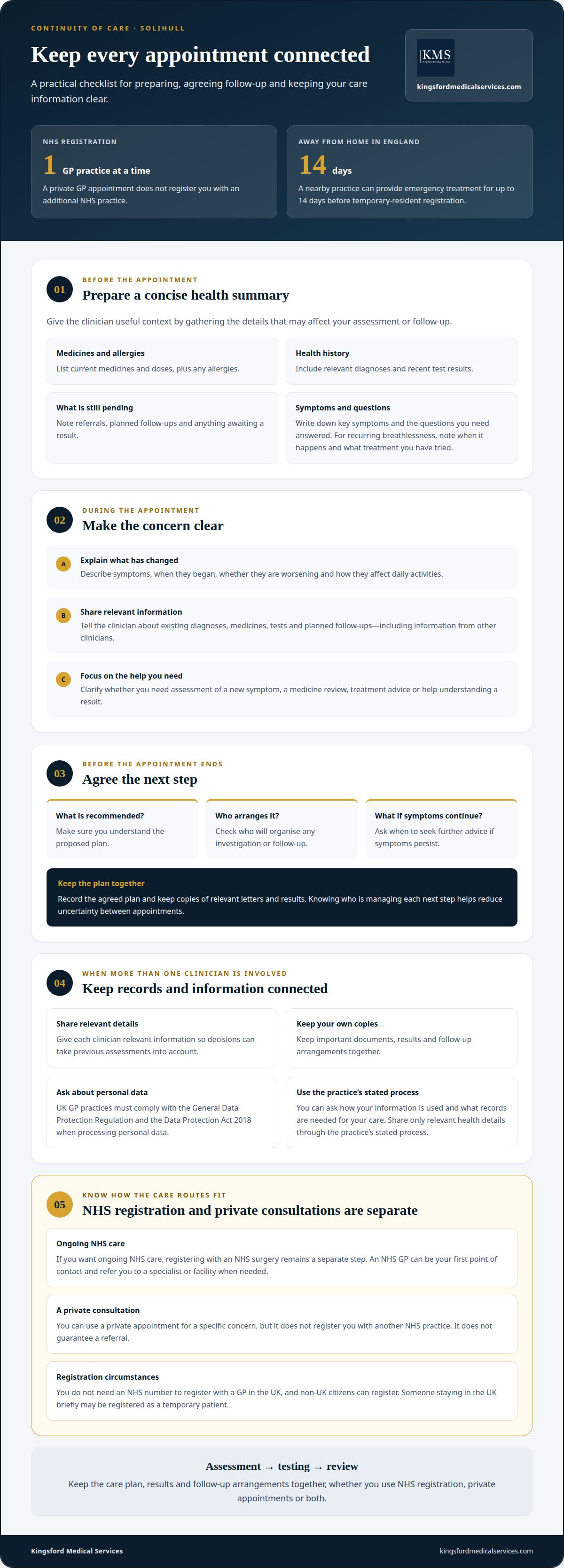
Continuity means that each appointment contributes to a clear picture of your health. In Solihull, this can matter when symptoms persist, treatment changes or several clinicians are involved. An NHS GP can be your first point of contact and refer you to a specialist or facility when needed. Keep track of who is managing each next step to avoid uncertainty between appointments.
In England, you can be registered with only one GP practice at a time. A private GP consultation does not register you with an additional NHS practice. If you want ongoing NHS care, registering with an NHS surgery remains a separate step. You can still use a private appointment for a specific concern, but tell the clinician about existing diagnoses, medicines, tests and planned follow-ups.
Make each consultation more useful by preparing a concise health summary. Include current medicines and doses, allergies, relevant diagnoses, recent test results and pending referrals. For example, if you’re discussing recurring breathlessness, note when it occurs and what treatment you’ve already tried. This gives the clinician practical context for deciding what needs assessment or follow-up.
Agree on the next step before the appointment ends. Ask what the clinician recommends, who will arrange any investigation and when you should seek further advice if symptoms continue. Record the plan and keep copies of relevant letters or results. If you see more than one clinician, share relevant information with each so decisions take previous assessments into account.
Patient information needs careful handling. UK GP practices must comply with the General Data Protection Regulation and the Data Protection Act 2018 when processing personal data. You can ask how your information is used and what records are needed for your care. Share only relevant health details through the practice’s stated process, and keep your own copies of important documents.
Registration remains possible for different circumstances. You do not need an NHS number to register with a GP in the UK, and non-UK citizens can register. Someone staying in the UK briefly may be registered as a temporary patient. If you are away from home in England and become ill, a nearby practice can provide emergency treatment for up to 14 days before temporary-resident registration.
Continuity is especially valuable when care involves several stages, such as assessment, testing and review. Whether you use NHS registration, private appointments or both, keep the care plan, results and follow-up arrangements together. This gives each clinician a clearer starting point for the next decision.
What if I can't get a timely GP appointment in Solihull?
Start by telling your GP practice what has changed and why you need an appointment. Describe your symptoms, when they began, whether they’re worsening and how they affect daily activities. This helps the practice understand your request and decide on an appropriate next step. If your condition changes while you’re waiting, contact the practice with the updated information.
Ask the receptionist what appointment options are available and whether a clinician can assess your request. Explain if you need help with a specific issue, such as a new symptom, a medicine concern or follow-up after treatment. If the appointment offered doesn’t address the problem, clarify what you still need and ask what route the practice recommends. Note the advice and any agreed arrangements.
Prepare for the appointment so the consultation can focus on your main concern:
Write down your key symptoms and the questions you need answered.
Have a current list of medicines and relevant test results to hand.
Explain what has changed and what outcome you need from the consultation.
If a routine appointment cannot meet your needs, a private GP appointment is another option for a consultation about a defined concern. It may help you discuss symptoms, receive clinical advice and understand possible next steps. It does not replace NHS registration or guarantee a referral. If specialist assessment or diagnostic tests are needed, a GP can refer you to a specialist or facility within the NHS pathway.
Choose the route that fits the problem. For a new, non-emergency concern, describe your symptoms and ask about the appropriate assessment. For an existing condition, identify whether you need a review, treatment advice or help understanding a result. A focused private consultation can address a particular issue, while ongoing NHS care remains organised through your registered practice.
If you’re considering an alternative to an NHS GP in Solihull, private GP appointments offer a route to discuss a specific health concern. Bring relevant details about symptoms, medicines and previous care, so the clinician can consider the issue in context. For symptoms that feel immediately life-threatening, seek emergency help rather than waiting for a routine appointment.
Practices solihull
Many GP surgeries in Solihull accept new patients who live within their practice boundary. First identify practices that cover your address, then check whether their lists are open. A practice boundary determines whether your home falls within its catchment area, so the nearest surgery may not be the one that covers your address.
In England, you have a legal right to choose a GP practice that suits your needs. However, a practice may refuse registration on reasonable grounds. Examples include an agreed closure of its list to new patients or your address being outside its boundary. If a surgery refuses your application, it should give its reasons in writing. That explanation can help you decide where to apply next.
Use a straightforward sequence when approaching a surgery:
Find practices whose boundaries may include your home address.
Ask whether the practice is accepting registrations and how to apply.
Submit the registration through the practice website, NHS App or a paper form in person.
Complete any registration form the practice requests, then follow its instructions about next steps.
Practices typically ask new patients to complete a GMS1 form. Some also request a health check with a nurse or healthcare assistant. A practice can ask for proof of identity, particularly when registering children in your care. However, it should not refuse registration solely because you lack identity documents or supporting paperwork, if you state that you live within its catchment area.
Registration is not restricted to UK citizens, and you do not need an NHS number to apply. If you’re homeless, you can register using a temporary address, such as a friend’s address or a day centre. If you need help completing a form, ask the GP receptionist to arrange an interpreter. This service is provided without charge.
Someone who cannot register because they lack capacity may have another person apply on their behalf. This can include a relative, carer, friend, court-appointed person or lasting power of attorney. For a person staying in England temporarily, ask the surgery about temporary-patient registration. If you are away from home and become ill, a nearby practice can provide emergency treatment for up to 14 days before you register as a temporary resident.
Keep a copy of your application and any written response. If a practice’s list is closed, use its stated reason to guide your next application, particularly if the issue is the catchment boundary. This gives you a practical route towards NHS registration while you consider other ways to access a consultation.
Before submitting the form, ask what the practice expects, including whether it requires a health check with a nurse or healthcare assistant. Many GP practices require this check for new patients, so asking in advance can help you prepare and understand any further steps the surgery may request.
Any refusal must be based on reasonable grounds. Examples include an agreed closure of the practice list to new patients or the patient living outside the practice boundary. Knowing which ground applies can help you decide what to ask the practice and whether its registration requirements fit your circumstances.
Kingsford Medical Services
Kingsford Medical Services offers private care for people seeking a focused consultation alongside their NHS care. Its services include respiratory and sleep medicine consultations, paediatric services, vitamin B12 testing and treatment, and psychiatry services. These options may suit you when your concern relates to one of these areas and you want a dedicated clinical appointment to discuss it.
Private consultations are separate from NHS registration and do not replace an NHS GP relationship. They offer an additional way to discuss a specific health concern, while your NHS practice remains responsible for care arranged through it. For urgent or life-threatening symptoms, seek emergency help rather than relying on a routine private appointment.
If you’d like to discuss whether this care suits your needs, contact Kingsford Medical Services.
Choose the next step that keeps your care moving
Your next step is to decide what you need from care now and what should happen afterwards. If you’re considering an alternative to an NHS GP in Solihull, look beyond the immediate appointment. Identify the main concern you want addressed, the outcome you need and any follow-up that may be required. This gives your consultation a clear purpose and helps you explain what matters most.
It can also help to decide how private care would fit alongside your existing NHS arrangements. A focused appointment may address a particular concern, while ongoing care and follow-up can involve different routes. Being clear about the role you want each appointment to play can help you make a considered decision.
For a calm conversation about your options and the care that may suit your needs, contact Kingsford Medical Services. Taking one considered step can help you move forward with greater clarity.
Frequently Asked Questions
What alternatives to an NHS GP are available in Solihull?
Options include applying to another NHS practice whose boundary covers your address or booking a private GP appointment for a specific concern. Private care complements, rather than replaces, your NHS GP. In Knowle, Solihull, Kingsford Medical Services offers private GP appointments and focused specialist consultations, including respiratory and sleep medicine and paediatric care. The right route depends on whether you need ongoing NHS registration or an additional consultation.

Comments