
Employee wellness checks in Solihull and what they cover
How often can you access an employee wellness check? For employee wellness checks in Solihull, the schedule depends on the workplace programme; there is no single frequency for every member of staff. Checks can provide a useful snapshot of health, but access arrangements vary between employers.
It’s reasonable to want clarity before taking part, especially when work pressures make it difficult to prioritise your wellbeing. A check can highlight health measures that may need attention and give you a clearer picture of your current health.
This article explains what checks may cover, how employers arrange staff access and why workplace health matters for productivity and job satisfaction. It also explains when a health concern may call for an individual medical assessment, helping you understand the purpose of each option and what to expect.
Table of Contents
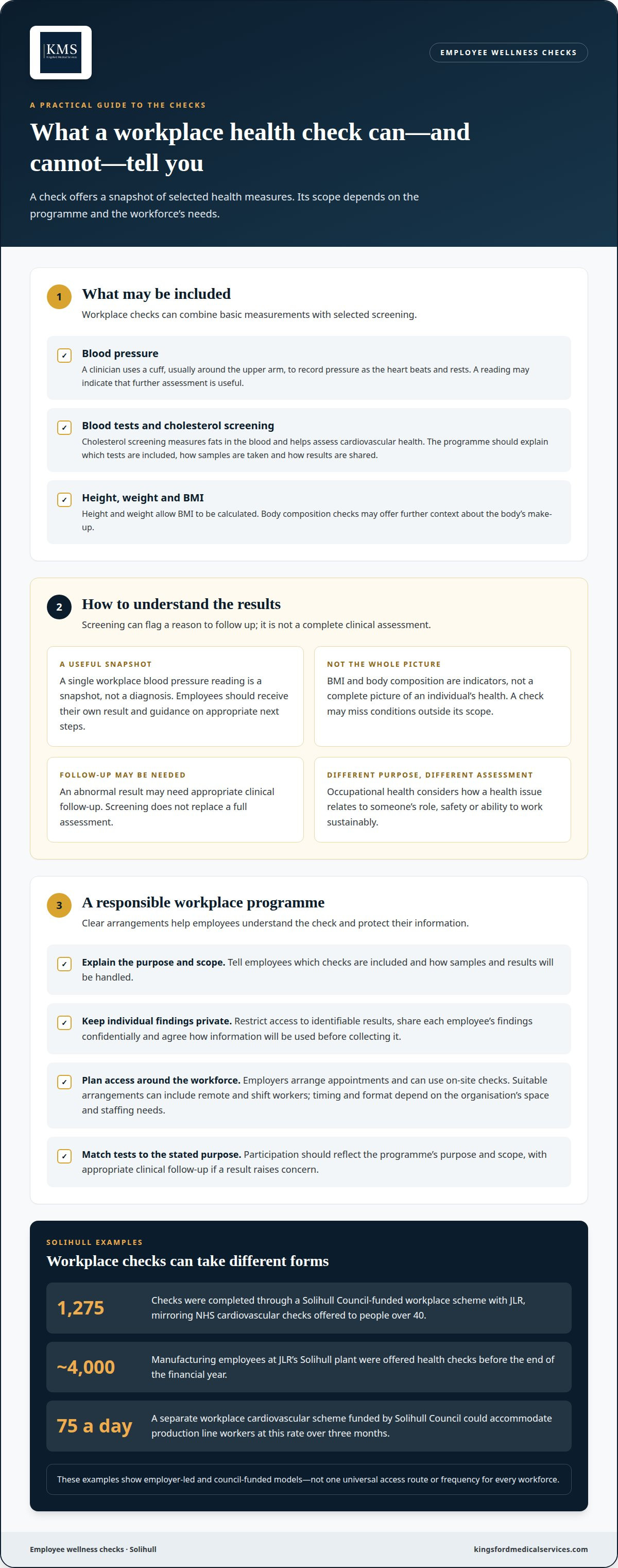
Checks include blood pressure, cholesterol, height, weight and BMI
Workplace checks may combine basic measurements with selected screening to identify issues for follow-up. Their scope depends on the programme and the workforce’s needs.
Blood pressure checks
A clinician measures blood pressure with a cuff, usually placed around the upper arm. The result records pressure as the heart beats and rests, and may indicate that further assessment is useful. A single workplace reading is a snapshot, not a diagnosis. Employees should receive their own result and guidance on appropriate next steps.
Blood tests and screening
Blood tests may include cholesterol screening, which measures fats in the blood and helps assess cardiovascular health. The programme should explain which tests are included, how samples are taken and how results are shared. Screening may identify a reason for clinical follow-up, but it does not replace a full assessment. Tests should match the stated purpose of the check.
Height and weight measurements allow BMI to be calculated, while body composition checks may offer further context about the body’s make-up. These are indicators, not a complete picture of an individual’s health.
Unlike a general wellness check, an occupational health assessment considers how a health issue relates to someone’s role, safety or ability to work sustainably.
Solihull has had a Council-funded workplace scheme with JLR, which completed 1,275 checks and mirrored NHS cardiovascular checks offered to people over 40.
According to UK legislation, the Equality Act 2010 is relevant to employers’ reasonable-adjustment responsibilities in Solihull. Occupational health assessment can also support consideration of workplace risks, including COSHH exposure, noise or vibration.
Explain the purpose of each check, restrict access to identifiable results and communicate individual findings privately. Agree how information will be used before collecting it.
On-site checks can take place at a workplace, with the format and timing shaped by the organisation’s space and staffing needs.
Employers usually define the scope of a check, arrange appointments, explain participation and share results confidentially with each employee.
Remote and shift workers can be included through suitable appointment arrangements. Participation should reflect the programme’s purpose and scope.
A check is only a snapshot. It may miss conditions outside its scope, and an abnormal result needs appropriate clinical follow-up.
Potential effects on productivity and job satisfaction
Employee health can affect concentration, energy and the ability to complete routine tasks. Pain or disrupted sleep, for example, may make a physical shift harder to manage, while mental health difficulties can affect focus and communication. A check may prompt an employee to seek follow-up, but its value depends on the support available after screening.
Workplace culture matters too. A May 2024 JLR employee wellbeing survey found that 74.8% of 18,000 employees felt their manager cared for them. The same survey reported that 73.9% felt supported to make decisions about their health and wellbeing. These findings illustrate how perceived support and employee health can be relevant to job satisfaction.
Employers can link screening with practical support: explain how results are handled, make appropriate occupational health services accessible and signpost relevant health services. If an employee raises concerns about workload, fatigue or stress, a private conversation can help identify suitable workplace changes or clinical support. Screening alone does not resolve the underlying issue.
There is also a potential business case. In 2022, UK employers saw an average return of £10.85 for every £1 spent on an employee assistance programme, attributed to reduced absenteeism and increased productivity. This figure describes an average, not a guaranteed result for an individual organisation. Programme design, access and employee awareness affect whether support can be used.
To make a wellness programme useful, organisations can review participation, recurring health concerns and employee feedback, then adjust communications or support routes. Keep screening voluntary and distinct from performance management. For an individual mental health concern, support for mental wellbeing can be a practical next step alongside appropriate workplace support.
Which providers offer employee health and wellness checks in Solihull?
Solihull employers can arrange checks through occupational health providers, private medical clinics or workplace health programmes. The right option depends on whether the priority is general screening, a role-related assessment or follow-up for a specific concern.
Local programmes show how checks can be delivered at scale. JLR offered health checks to approximately 4,000 manufacturing employees at its Solihull plant before the end of the financial year. A separate workplace cardiovascular scheme, funded by Solihull Council, could accommodate 75 production line workers a day over three months. These examples demonstrate employer-led and council-funded models, rather than a single access route for every workforce.
Occupational health providers focus on the relationship between an employee’s health and their work. Employers may arrange an assessment when a health issue could affect safe or sustainable working, or when staff face workplace exposures such as noise, vibration or COSHH risks. General wellness screening has a different purpose: it provides health information and may prompt clinical follow-up, but does not replace a role-specific assessment.
Employee assistance programmes are another form of support, not a substitute for clinical screening. Depending on the programme, they may include telephone support, face-to-face counselling or referrals to specialist services. Access frequency and counselling limits vary, and some programmes include employees’ immediate family members.
Before arranging a service, define the intended outcome and consider these practical points:
Scope: decide whether staff need general checks, occupational health assessments or both.
Delivery: consider on-site sessions for manufacturing shifts, or appointment-based access for dispersed teams.
Follow-up: establish how employees receive results and how onward clinical support is handled.
Access: plan for remote staff, shift patterns and private conversations about individual results.
These distinctions help organisations in Solihull choose support that fits the health question, workforce and workplace setting.
JLR invested £15 million per year in its global health and wellbeing programmes, illustrating the scale of employer investment that can sit alongside local checks. Consider occupational health referral when a health issue may affect an employee’s ability to work safely or sustainably. Occupational health assessments can also help Solihull employers address COSHH requirements.
How much do employee wellbeing checks cost in Solihull?
There is no standard cost for every Solihull workplace programme. For employee wellness checks in Solihull, the total depends on what the checks include, how many employees take part and how they are delivered. A basic appointment with measurements differs from a programme that includes blood tests, individual consultations or occupational health assessments.
A tailored quote depends on the scope, workforce size, delivery arrangements and follow-up required, and is provided after a quote request. Employers can clarify likely costs by defining the purpose first. For example, screening focused on cardiovascular health may require different tests and clinical time from assessments for employees with specific work-related concerns. The proposed scope is therefore important when estimating the cost of employee wellness checks in Solihull.
Delivery also affects the estimate. On-site sessions may require a suitable private space and appointments coordinated around shifts. Clinic-based appointments mean employees attend individually. For a workforce spread across Solihull, travel and scheduling may shape the practical plan. Ask for the proposed format and included services to be itemised, so the organisation can see what the quote covers.
Purpose: decide whether the priority is general screening, occupational health or both.
Checks: list requested measurements, blood tests and any individual consultations.
Participation: estimate staff numbers and identify shift or remote-working arrangements.
Follow-up: clarify how employees receive results and what clinical support is included.
This information helps providers define the service accurately and prevents comparisons between unlike proposals. A quote for screening alone may not include occupational health advice or onward referrals. A programme with blood testing may also require different clinical arrangements from one with basic measurements. Compare the stated scope, delivery method and follow-up provisions, not just the headline total.
For a tailored discussion of health support, explore your options.
Kingsford Medical Services
Kingsford Medical Services can help when a workplace check raises a personal health concern that needs clinical attention. It provides individual consultations and services, complementing rather than replacing an employer’s workforce-wide screening or occupational health programme.
For example, persistent sleep difficulties may call for Respiratory & Sleep Medicine Consultations, while concerns about mental health may be supported through Psychiatry Services. Vitamin B12 Testing & Treatment and Paediatric Services are also available where relevant to an individual’s needs. The appropriate next step depends on the concern and the type of assessment or care required.
Employees can book an individual appointment to discuss symptoms or health questions in a clinical setting, separate from workplace screening. This can help clarify appropriate personal follow-up after receiving a check result.
For individual medical support after a workplace check, contact Kingsford Medical Services.
Choose a clear next step for your health
Workplace screening can be a useful prompt to take a closer look at your health. If you are considering employee wellness checks in Solihull, the next step is to understand what a result means for your circumstances and whether individual clinical advice could help.
Kingsford Medical Services offers Private GP Appointments for personal health concerns, alongside Respiratory & Sleep Medicine Consultations and Paediatric Services. These support individual medical needs and complement, rather than replace, an employer’s workplace screening or occupational health arrangements. A GP appointment can help you discuss a concern raised by a check and consider appropriate follow-up.
Taking action can begin with a focused conversation about the issue that matters to you. Contact Kingsford Medical Services to discuss your health needs and possible next steps. A considered, individual approach can make it easier to move forward with confidence.
Frequently Asked Questions
What are employee wellness checks and what do they include?
Employee wellness checks are health assessments arranged through a workplace programme to give staff information about aspects of their health. Depending on the programme, they may involve measurements, screening and a private discussion of results. For example, an employee concerned about a reading can use it as a prompt to seek individual clinical advice. A workplace check is not a substitute for diagnosis or ongoing medical care.
What tests and health assessments are typically included?
Common checks may assess blood pressure, cholesterol, height, weight and BMI, with blood tests or other screening included according to the programme’s purpose. Some workplace schemes focus on cardiovascular risk, while occupational health assessments consider how a health concern relates to a person’s duties. An employee with persistent symptoms may need a separate clinical assessment, because a screening result alone cannot explain every health issue.



Comments