
NHS waiting lists in Birmingham: comparing hospitals and options
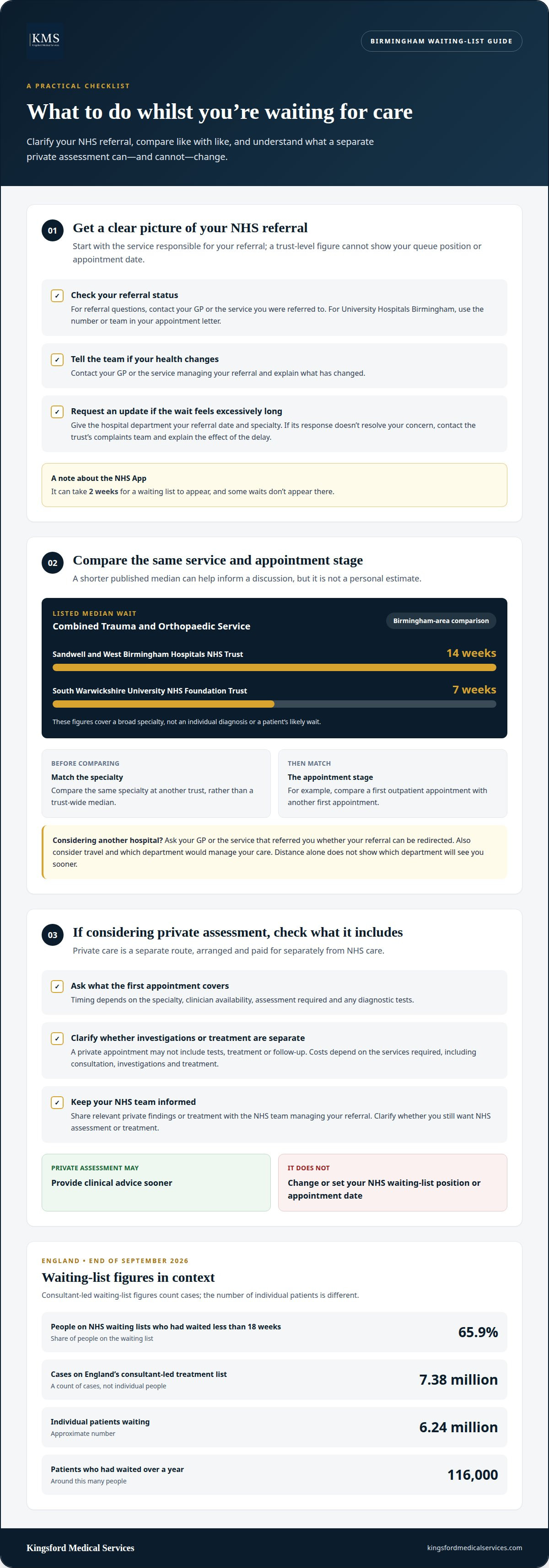
The nearest NHS trust isn’t always the one with the shortest wait. In a Birmingham-area comparison, the listed median wait for the combined Trauma and Orthopaedic Service is 14 weeks at Sandwell and West Birmingham Hospitals NHS Trust, compared with 7 weeks at South Warwickshire University NHS Foundation Trust. These figures cover a broad specialty, not an individual patient’s likely wait.
If you’re tired of NHS waiting lists in Birmingham, it’s understandable to want a clear picture of your options. Trust-level waiting times can help you compare services, but they don’t show your place in a queue or when you’ll be seen.
This guide explains how to interpret local hospital comparisons, what can affect your wait, and how NHS and private care differ. It also outlines when a private consultation may provide an assessment for concerns such as respiratory symptoms, sleep problems or a child’s health, and which needs require NHS care.
Table of Contents
Comparing the nearest hospital with faster alternatives
An outpatient wait is the time between referral and a first hospital specialist appointment. At University Hospitals Birmingham NHS Foundation Trust, average first-appointment waits varied by specialty on 13 November 2026. Gynaecology averaged 27 weeks, oral surgery 32 weeks and maxillofacial surgery 31 weeks. Neurology averaged 28 weeks, pain management 29 weeks and urology 26 weeks. General surgery averaged 19 weeks, colorectal care 20 weeks and ear, nose and throat care 21 weeks. These averages don’t predict an individual appointment date.
A median is the midpoint of recorded waits, not a personal estimate. Birmingham-area comparisons cover 13 NHS trusts and rank the combined Trauma and Orthopaedic Service. This specialty includes conditions beyond any single diagnosis. Listed medians include 11 weeks at Walsall Healthcare NHS Trust and 13 weeks at Dudley Group NHS Foundation Trust. University Hospitals Coventry and Warwickshire NHS Trust also lists 13 weeks, while Worcestershire Acute Hospitals NHS Trust lists 19 weeks. The ranking includes acute and specialist trusts with at least 50 people on the relevant waiting list.
Sandwell and West Birmingham Hospitals NHS Trust is 2.2 miles from central Birmingham. South Warwickshire University NHS Foundation Trust is 18.8 miles away. Distance alone doesn’t show which department will see you sooner. Compare the same specialty and appointment stage, such as a first outpatient appointment with another first appointment.
For University Hospitals Birmingham contact details, use the number or team shown in your appointment letter. For referral questions, contact your GP or the service you were referred to. The NHS App can take 2 weeks to display a waiting list, and some waits don’t appear there. Trust-level figures can’t show your queue position or appointment date.
To explore switching hospitals, ask your GP or the service that referred you whether your referral can be redirected. Compare the same specialty at the alternative trust, then consider travel and which department would manage your care. A shorter published median can inform the discussion, but it doesn’t establish your individual wait.
Ways to manage or reduce time waiting for treatment
A consultant-led waiting list records cases awaiting specialist treatment after referral. If you’re tired of NHS waiting lists in Birmingham, clarify your referral status, report changes in your health and consider whether a separate private assessment meets your needs.
Private treatment waiting times
A private waiting time is the interval between arranging care and receiving an appointment or treatment. In Birmingham, timing depends on the specialty, clinician availability, assessment required and any diagnostic tests. Before booking, establish what the first appointment covers and whether investigations or treatment involve separate arrangements. A private assessment may provide clinical advice sooner, but it doesn’t change your NHS waiting-list position. For a focused discussion of symptoms, a private GP appointment is one possible route.
Private care alongside an NHS wait
Private care alongside an NHS referral means pursuing a private assessment while remaining in contact with the NHS team managing your referral. Tell that team about private findings or treatment so relevant information can inform your ongoing care. Clarify how the private appointment relates to the condition under NHS review and whether you still want NHS assessment or treatment. These are separate pathways, so a private appointment doesn’t provide an NHS appointment date.
The share treated within 18 weeks shows how much of a waiting list meets that timeframe. At the end of September 2026, 65.9% of people on NHS waiting lists in England had waited less than 18 weeks. Consultant-led figures count cases: 7.38 million cases were on England’s treatment list that month, while approximately 6.24 million individual patients were waiting. Around 116,000 patients had waited over a year, showing why elective waits remain a concern.
If you’re tired of NHS waiting lists in Birmingham and your health worsens, contact your GP or the service managing your referral and explain what has changed. If the wait feels excessively long, give the hospital department your referral date and specialty, then request an update. If its response doesn’t resolve your concern, contact the trust’s complaints team and explain the effect of the delay.
How private and NHS waiting times differ
An NHS waiting time measures the interval within a publicly funded referral and treatment pathway. Private care is arranged and paid for separately; appointment timing depends on the service, clinician availability and investigations needed.
In England, consultant-led waiting-list figures count cases, while diagnostic-test figures use a separate six-week standard. These measures describe different stages of care, so a hospital’s outpatient wait cannot be directly compared with a scan or treatment wait. Birmingham NHS Foundation Trust figures also vary by specialty and appointment stage.
Private appointments may offer another route to assessment, but they don’t automatically include tests, treatment or follow-up. Ask what the appointment covers, whether investigations are separate, and how findings can be shared with your NHS team. The NHS pathway remains distinct; private attendance doesn’t set or predict an NHS appointment date.
Costs are an important difference: NHS care is publicly funded for eligible patients, while private care involves payment for the services used. Private-care prices depend on the case and are given after a quote request; relevant factors include the consultation, investigations and treatment required.
Delaying assessment can prolong uncertainty and may allow a health problem to worsen, depending on its cause and symptoms. Private care also involves costs, and choosing it doesn’t guarantee a faster diagnosis or better outcome. Seek urgent help if symptoms become severe or rapidly worsen.
For cancer pathways, England’s operational standards are distinct from ordinary elective-treatment waits. The standard is for 96% of patients to receive first or subsequent cancer treatment within 31 days of a decision to treat; for first definitive treatment within 62 days of an urgent referral or consultant upgrade, it is 85%. These are service standards, not personal appointment guarantees.
Compare like with like before deciding: identify whether you need a consultation, diagnostic test or treatment, then consider the care pathway, expected steps and affordability. This helps you weigh private access against continuing NHS care without treating different waiting-list measures as equivalent timeframes.
Can I use private treatment while staying on an NHS waiting list?
Yes, you can pursue private treatment alongside an NHS referral, but the pathways are separate. If you’re tired of NHS waiting lists in Birmingham, consider what you need from a private appointment while keeping the NHS team responsible for your referral informed about relevant changes.
Private assessment means seeing a clinician outside the NHS pathway, with payment for the care received. Before arranging an appointment, clarify what it covers, whether tests or follow-up are separate, and how findings will be recorded. A consultation can provide an assessment, but it doesn’t automatically include a procedure or advance your NHS referral.
To support coordinated care, tell the private clinician that you’re awaiting NHS care and identify the hospital or department managing your referral. Request a written summary of relevant findings, then share it with the NHS team. Information about investigations, medicines or treatment already discussed can help both teams understand the care you’ve received.
Keep referral details and NHS appointment communications together. If private care leads to treatment for the same condition, inform the NHS department so it can consider what has changed and explain the next steps. Don’t assume private treatment automatically cancels, pauses or preserves an NHS place; ask the service handling your referral about your status.
For people tired of NHS waiting lists in Birmingham, the decision may depend on the assessment needed, the next clinical step and the costs involved. Consider whether you need an initial consultation, diagnostic investigations or ongoing treatment. These may be separate parts of private care, so clarify the scope before proceeding.
If symptoms worsen, tell your GP or NHS service promptly rather than waiting for a private appointment. For urgent or severe symptoms, seek urgent medical help. Keep both care teams informed and ask how new clinical information should reach the NHS department. Clear communication can help you make a considered choice between pathways.
Kingsford Medical Services
Kingsford Medical Services offers private consultations for people seeking assessment while considering their NHS care options. Its services include respiratory and sleep medicine consultations, paediatric services, Vitamin B12 testing and treatment, and psychiatry services. These may be relevant when your concern relates to breathing or sleep symptoms, a child’s health, possible vitamin B12 issues or mental wellbeing.
A private appointment is a separate route to assessment; it doesn’t replace an NHS referral or determine your place on an NHS waiting list. If you’re unsure which consultation fits your concern, describe your symptoms and what assessment you’re seeking when you contact Kingsford Medical Services in Knowle, Solihull.
For a considered discussion of your healthcare options, contact Kingsford Medical Services.
Choose the next step that fits your needs
If you’re tired of NHS waiting lists in Birmingham, focus on what would help you make a clear, informed decision now. That might mean clarifying your NHS referral, discussing a change in symptoms with your GP, or considering a separate private assessment. The right route depends on the care you need and what you want the next appointment to address.
Kingsford Medical Services offers Private GP Appointments, Respiratory & Sleep Medicine Consultations and Paediatric Services in Knowle, Solihull. These give people across Birmingham, Nuneaton and the wider West Midlands private options for medical advice about their health, breathing or sleep concerns, or a child’s wellbeing. Private care complements NHS GP services and is separate from NHS treatment, so keep the NHS team managing your referral informed about relevant findings.
Take the next step at a pace that feels manageable. Contact Kingsford Medical Services to discuss your healthcare needs and the available consultation options.
Frequently Asked Questions
What is the backlog?
The NHS backlog is the volume of outstanding care people are waiting to receive, including specialist appointments and treatment. Consultant-led waiting-list totals count cases, not necessarily a separate person for each entry. A backlog figure describes demand across a service; it doesn’t show how long one particular patient has waited, their place in the queue or the date of their next appointment.
What makes private healthcare timelines different to the NHS?
Private care is arranged through a separate pathway, with appointments and investigations depending on the service needed and clinician availability. Patients pay directly for private consultations or tests, while NHS care follows its own referral and treatment process. Choosing a private appointment doesn’t itself change an NHS referral. Before proceeding, establish whether the private appointment covers assessment alone or includes the next step you need.
How long are NHS waiting times for elective treatment in Birmingham?
There isn’t one waiting time for every Birmingham elective procedure; the specialty and stage of care matter. As listed on 28 November 2025, University Hospitals Birmingham NHS Foundation Trust had waits of 20 weeks for orthopaedics, 36 weeks for general surgery and 39 weeks for ophthalmology. These dated trust figures are not individual appointment estimates, and they don’t indicate your current queue position.
Can I ask to be referred to a different NHS hospital with a shorter waiting time?
You can discuss a different hospital with the GP or service handling your referral and ask whether it can be redirected. Explain the specialty you need and the alternative trust you’re considering. A shorter published median may help inform that conversation, but it covers a group of patients, not your individual case. Also consider travel and whether the alternative offers the same type of appointment or treatment.


Comments