
Hormone Level Blood Test Birmingham: A Patient’s Guide to Choosing the Right Test
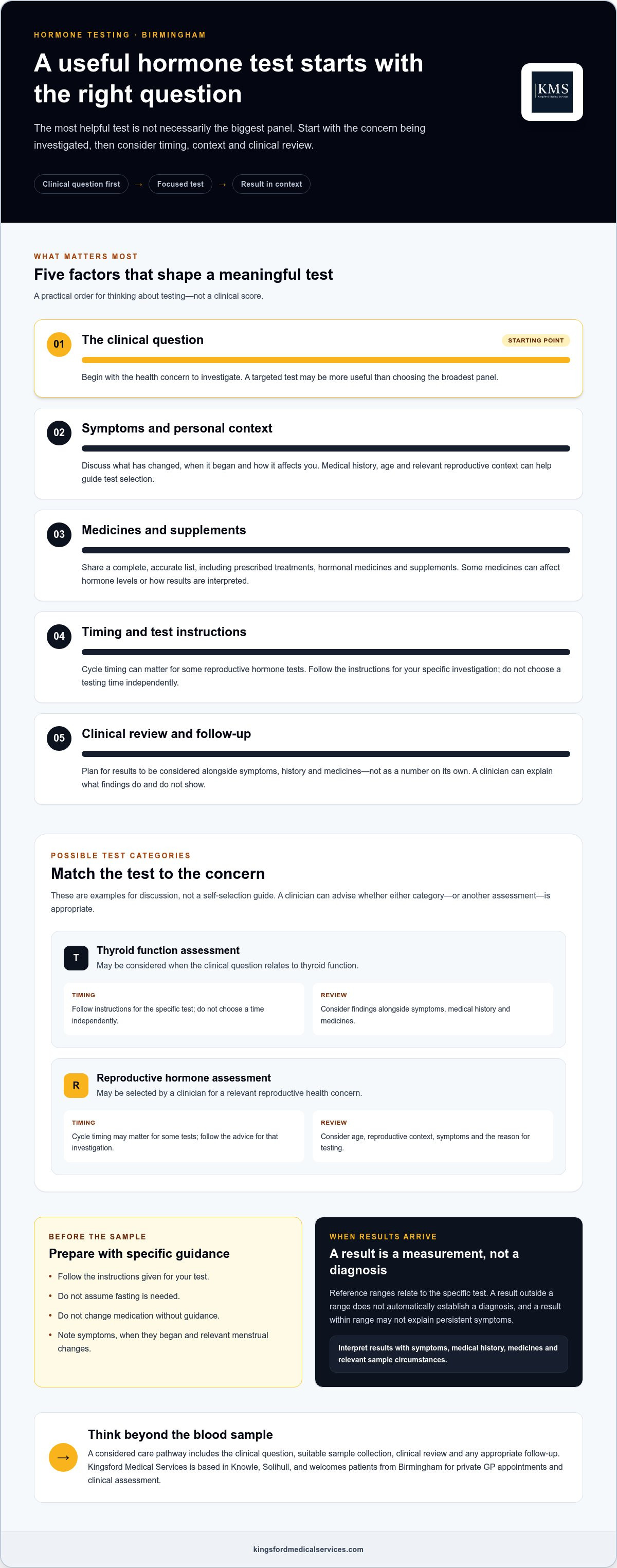
The right hormone test isn’t necessarily the biggest panel. For a hormone level blood test Birmingham patients need, the most useful starting point is the health concern being investigated, not a long list of markers.
It’s understandable to feel unsure about which test may be relevant, or whether your menstrual cycle, medication or the time of day could affect a result. A blood test can provide useful information, but it needs to be considered alongside your health history and symptoms. A clinician-led assessment can help identify an appropriate next step and explain what the findings may mean.
This guide covers which hormone tests may be relevant, why preparation and timing matter, and what to consider when arranging care in Birmingham. Kingsford Medical Services is based in Knowle, Solihull, and welcomes patients from Birmingham for private GP appointments and clinical assessment. You’ll also learn how results can be reviewed in context, so you can understand possible follow-up options rather than being left to interpret a number on its own.
Table of Contents
What can a hormone level blood test in Birmingham help investigate?
Choosing a hormone blood test in Birmingham: match the test to your symptoms
Private hormone testing near Birmingham: compare the care pathway, not just the sample
How to prepare for a hormone level blood test and understand the result
Arrange a hormone test discussion with Kingsford Medical Services near Birmingham
What can a hormone level blood test in Birmingham help investigate?
Changes in energy, mood or menstrual patterns can prompt questions about hormones. A hormone level blood test Birmingham patients may discuss with a clinician measures selected hormones in a blood sample. It doesn’t measure every hormone or provide a complete picture of health by itself. The choice of test depends on what needs investigating.
Symptoms, medical history and medicines help determine whether testing is appropriate and which measurements may be useful. Some medicines can affect hormone levels or how results are interpreted, so give the clinician a complete and accurate account, including prescribed treatments and supplements. Testing may be one part of an assessment rather than the first or only step.
A test result is a measurement, not a diagnosis. It needs to be interpreted alongside symptoms, medical history and other relevant findings before deciding what it means for you.
Which symptoms might prompt a clinician to consider hormone testing?
A clinician may consider testing when symptoms or a health concern raise a specific clinical question. Examples include changes in menstrual patterns, fertility concerns, or symptoms that could suggest altered thyroid function. These experiences can have multiple causes. On their own, they don’t prove that a hormone disorder is present or show which test should be chosen.
Before an assessment, note when symptoms began, whether they come and go, and how they affect everyday activities, sleep or wellbeing. If relevant, record changes in your menstrual pattern and any medicines you take. These details help the clinician understand the context and decide whether a blood test may add useful information.
Thyroid testing is one example of a targeted investigation. Thyroid function tests (TFTs) are a collective term for blood tests used to check the function of the thyroid. A clinician can consider whether this type of assessment fits the symptoms and clinical question, rather than assuming that every symptom points to the thyroid.
Why one hormone test cannot answer every health question
Different tests measure different hormones and help explore different questions. A thyroid function assessment, for example, addresses a different clinical question from an assessment of reproductive hormones. The relevant test depends on the concern being investigated. Sometimes another kind of assessment may be more appropriate.
Results also need context. Reference ranges relate to the specific test, and interpretation may depend on factors such as your medical history, medicines and, for some tests, the circumstances in which the sample was taken. A value outside a reference range doesn’t automatically establish a diagnosis. A value within range doesn’t always explain persistent symptoms.
A broad hormone panel isn’t automatically more helpful or necessary. A clinician-led assessment can focus testing on the question that matters, then explain what the findings do and don’t show. This makes the result more meaningful and supports considered decisions about further assessment or follow-up.
Choosing a hormone blood test in Birmingham: match the test to your symptoms
Choosing a test starts with the question that needs answering, not with selecting the broadest package. A clinician considers your symptoms, medical history, age, medicines and relevant reproductive context before deciding whether hormone testing may help. Similar symptoms can have different causes, so this assessment helps keep investigations focused and results meaningful.
What should guide the choice of hormone test?
The appropriate test depends on the clinical question, not a generic package. For example, a clinician may consider thyroid function tests when the history suggests a thyroid-related question, or a reproductive hormone assessment when investigating a relevant concern. These are possibilities, not recommendations for everyone with particular symptoms.
Other investigations may be more useful, or testing may not be the most appropriate next step. Be ready to explain what has changed, when it began and how it affects you. Mention relevant diagnoses and all medicines, including hormonal treatments, as these details can influence which test is selected and how the findings are reviewed.
This comparison is a starting point for discussion, not a self-selection guide. The same symptom can lead to different decisions depending on its duration, associated features and personal circumstances. A hormone level blood test Birmingham patients consider is most useful when the test, timing and planned review all relate to a clear clinical question.
When can timing affect a hormone blood test?
Timing requirements vary according to the hormone being measured, the purpose of the test and individual circumstances. For some reproductive hormone assessments, menstrual-cycle timing may be relevant. Other tests may have different instructions. There isn’t one date or preparation routine that suits every hormone test.
Before arranging your sample, follow the clinician’s and laboratory’s test-specific instructions. If you’re unsure how they apply to your circumstances, clarify this before choosing a sampling date. Don’t change medication or assume a particular cycle day is required unless you’ve been advised to do so.
If you’re unsure how to frame the clinical question, a private GP appointment can help you discuss your symptoms and possible next steps. Kingsford Medical Services is based in Knowle, Solihull, and serves patients from Birmingham and the wider West Midlands.
Private hormone testing near Birmingham: compare the care pathway, not just the sample
A blood sample is only one part of hormone testing. Before choosing a route, consider how the clinical question will be assessed, how the sample will be collected, who will review the result and what happens if it needs follow-up. A test-only option may provide a measurement, while a clinician-led pathway connects the investigation with your symptoms and health history.
That distinction matters because a result without context may not answer the concern that prompted testing. A value needs to be considered alongside relevant symptoms, medicines and medical history. If a finding is unexpected, you’ll want to understand what it means and whether further discussion or assessment is appropriate. Clear review helps make a laboratory figure useful without treating the result alone as a diagnosis.
What to look for in a clear testing pathway
A well-explained pathway should make clear how the test relates to your concern and how its result will be reviewed. Consider whether your symptom history and the purpose of the investigation will be taken into account, and whether you’ll have a chance to discuss relevant findings and possible next steps. This is particularly useful if you’re unsure whether testing is the right first step or what a result could clarify.
For a hormone level blood test Birmingham patients are considering, it can help to map the process in stages:
Assessment: discuss the concern, symptoms and relevant medical history.
Testing: understand what the selected investigation is intended to assess and how sample collection is arranged.
Review: establish how the result will be explained in the context of your original concern.
Follow-up: discuss whether any further assessment or action is appropriate.
These are practical points to understand before proceeding, not a reason to request a particular test. Kingsford Medical Services provides private GP appointments and diagnostic care, so a clinician-led discussion can help relate an investigation to your individual circumstances.
Considering care in Birmingham, Solihull and Knowle
Kingsford Medical Services is based in Knowle, Solihull, and serves Birmingham and the wider West Midlands. When arranging care, consider the journey to the clinic and whether an in-person visit is needed for a blood sample. An e-consultation can support a clinical discussion, while blood sampling requires a separate arrangement.
If your aim is broader screening rather than investigating a particular hormone-related concern, consider whether a general health assessment better matches your needs. Keeping that distinction clear can help avoid testing that doesn’t address your main question.
For a considered discussion of symptoms, testing and follow-up, explore Kingsford’s private GP and diagnostic care. A clear pathway can help you understand not only how a sample is taken, but how its findings may inform your next steps.
How to prepare for a hormone level blood test and understand the result
Good preparation helps ensure the sample is taken according to the requirements of the specific test. Instructions can differ, so don’t assume you need to fast, alter your medication or attend on a particular cycle day. Follow the guidance provided for your test, and speak to a clinician if anything is unclear before your appointment.
What to do before your blood sample
Use this simple sequence to prepare for your hormone level blood test in Birmingham:
Confirm the instructions. Read the guidance supplied for your particular test, including any advice about timing or preparation. If you haven’t received instructions or aren’t sure how to apply them, ask the clinician responsible for your care.
Share your medicines and supplements. Tell the clinician about prescribed medicines, hormonal treatments and supplements. Don’t stop or change a medicine unless a clinician advises you to.
Attend sampling as arranged. Follow the instructions you’ve been given for the sample. Preparation varies between tests, so don’t assume fasting is required or unnecessary without checking the specific guidance.
Arrange a result review. Know how the result will be communicated and how you can discuss what it means in relation to your symptoms.
These steps keep preparation practical without relying on a universal rule. If menstrual-cycle timing is relevant to your particular investigation, use the advice provided for that test rather than selecting a date yourself.
What happens after the result is available?
A result is most useful when reviewed alongside the reason for testing. A clinician may consider your symptoms, medical history, medicines, the test method and the reference ranges applicable to the laboratory result. Reference ranges provide context, but they don’t replace an individual clinical assessment.
An out-of-range result needs clinical interpretation, not self-diagnosis. A result outside a reference range doesn’t, on its own, confirm a condition or determine what should happen next. A clinician can explain whether the finding may be relevant to your original concern and whether further discussion, assessment or follow-up is appropriate. Equally, a result within range may not fully explain symptoms, so raise any ongoing concerns during the review.
Before discussing results, note whether your symptoms have changed since the sample was taken and prepare any questions you’d like answered. This gives the review a clear focus and helps you understand the reasoning behind any suggested next steps. If you develop new or worsening symptoms, seek appropriate clinical advice rather than waiting for a routine result discussion.
If you’d like support connecting test preparation and results with your health concerns, arrange a private GP appointment with Kingsford Medical Services. A clinician can discuss your symptoms and help explain appropriate follow-up.
Arrange a hormone test discussion with Kingsford Medical Services near Birmingham
If you’re considering a hormone level blood test Birmingham residents can access through private care, start with the concern you want to understand. Note your symptoms, when they began and what you hope an assessment will clarify. A focused discussion with a private GP can help establish whether testing may be appropriate and what the next step should be.
What to bring to a hormone-test discussion
A little preparation can make the conversation more useful. You don’t need to arrive with a particular test in mind. Bring a concise account of what has changed, relevant medical history and details of prescribed medicines or supplements. It can also help to write down your main question, so the clinician understands what matters most to you.
Symptoms: note when they started, how they have changed and their effect on daily life.
Health background: include relevant diagnoses, previous investigations and, where appropriate, reproductive or menstrual context.
Medicines: list prescribed treatments and supplements, including any hormonal medicines.
Your main concern: identify what you would most like the consultation to address.
These details give the clinician a clearer starting point. If testing is considered, follow the instructions for that specific investigation rather than relying on general advice about preparation or timing.
How Kingsford supports local patients through next steps
Kingsford Medical Services provides private GP appointments and diagnostic care from its clinic in Knowle, Solihull, serving Birmingham and the wider West Midlands, including patients from Nuneaton. Its GMC-registered clinicians can discuss your symptoms and help consider appropriate investigations. The clinic operates seven days a week.
A consultation is also an opportunity to understand how a test result will be considered in relation to your symptoms and medical history. Results are not interpreted in isolation: the clinical context helps inform whether further discussion or follow-up may be appropriate. For patients looking into local GP care, Kingsford’s private GP service in Solihull provides a clear route to discuss their concerns with a clinician.
Whether you’re at the stage of describing symptoms or already have a result you’d like to discuss, take the next step with a clinician-led conversation. Arrange a private medical appointment with Kingsford to discuss your concerns and appropriate care. An individual assessment can help you move from uncertainty towards a clearer plan.
Take the next step with a clear question in mind
You don’t need to arrive with a diagnosis or a test already chosen. Start with the change that concerns you most and what you’d like to understand. That gives your consultation a practical focus, whether the next step is hormone testing, another investigation or a different form of clinical advice.
If you’re considering a hormone level blood test Birmingham patients can access through private care, a conversation with a GP can help you decide what is appropriate for your circumstances. Kingsford Medical Services’ GMC-registered clinicians, led by Dr Farrukh Rauf and Dr Anbrin Farrukh, provide private GP appointments and diagnostic care for patients in Birmingham and the wider West Midlands from Knowle, Solihull.
Bring your main concern, a brief symptom timeline and details of relevant medicines. From there, you can discuss a sensible way forward with a clinician and understand how any findings might be reviewed in context. Arrange a private medical appointment with Kingsford to discuss your next step.
Frequently Asked Questions
Can I have a hormone blood test without a GP consultation?
Some services provide access to individual tests without a prior GP consultation, but that doesn’t mean every test is suitable for every concern. For a hormone level blood test Birmingham patients are considering, a private GP discussion can help determine whether testing is appropriate and what it may clarify. Kingsford’s private GP appointments in Knowle, Solihull offer a clinician-led way to discuss your concerns and possible next steps.
Do hormone blood tests need to be taken at a particular time?
Sometimes, depending on the hormone being measured, the reason for testing and your circumstances. For some reproductive hormone investigations, menstrual-cycle stage may be relevant; it isn’t a universal requirement. Follow the instructions provided for your specific test rather than choosing a sampling date based on general advice. Before the sample is taken, tell the clinician about medicines and supplements that could be relevant.
Do I need to fast before a hormone level blood test?
Not necessarily. Fasting isn’t a universal requirement for hormone blood tests. Preparation can depend on the particular test and whether other investigations are being taken from the same sample. Follow the instructions provided for your appointment rather than fasting as a precaution or changing your usual routine without advice. If the guidance is unclear, clarify it before attending so you can prepare appropriately.
What happens if my hormone blood test result is normal but I still have symptoms?
A result within the reference range doesn’t automatically explain persistent symptoms or exclude every possible cause. A clinician can consider whether the test addressed your original concern and whether other aspects of your health need discussion. Keep track of any changes and raise them during a review. Don’t stop prescribed treatment or start supplements based only on an online interpretation of your result.
Are private hormone blood tests available through the NHS?
NHS hormone testing is generally arranged when a clinician considers it appropriate for your symptoms or care. The tests offered and access routes depend on your clinical circumstances and local pathways, so eligibility isn’t the same for everyone. Private care is a separate route for discussing symptoms and diagnostic options.
Can a hormone blood test diagnose a hormone disorder on its own?
No. A blood result is one part of an assessment, and its significance can depend on your symptoms, medical history, medicines, sample timing and the laboratory’s reference range. A clinician can explain what the result may mean in your circumstances and whether further review is appropriate. Avoid using a single result to diagnose yourself or make changes to prescribed treatment without clinical advice.



Comments