
Who may consider a private adult ADHD assessment in the West Midlands
Adults whose difficulties with attention, organisation, impulsivity or restlessness affect everyday life may consider a private assessment for adult ADHD in the West Midlands. An assessment explores whether these difficulties fit ADHD, when they began and how they affect you now. It can also clarify what support may be appropriate.
If you’ve spent years struggling to focus, manage tasks or keep routines on track, understanding what may be behind these challenges can be a useful step. An assessment is more than a checklist: a psychiatrist considers your history, current difficulties and their impact, alongside other possible explanations.
This guide explains who may benefit from an assessment, how a psychiatrist-led diagnostic process works and what can affect the cost. It also outlines how to access private care in Birmingham and across the West Midlands, so you can make your next decision with a clearer idea of what to expect.
Table of Contents
Who Should Consider An ADHD Assessment?
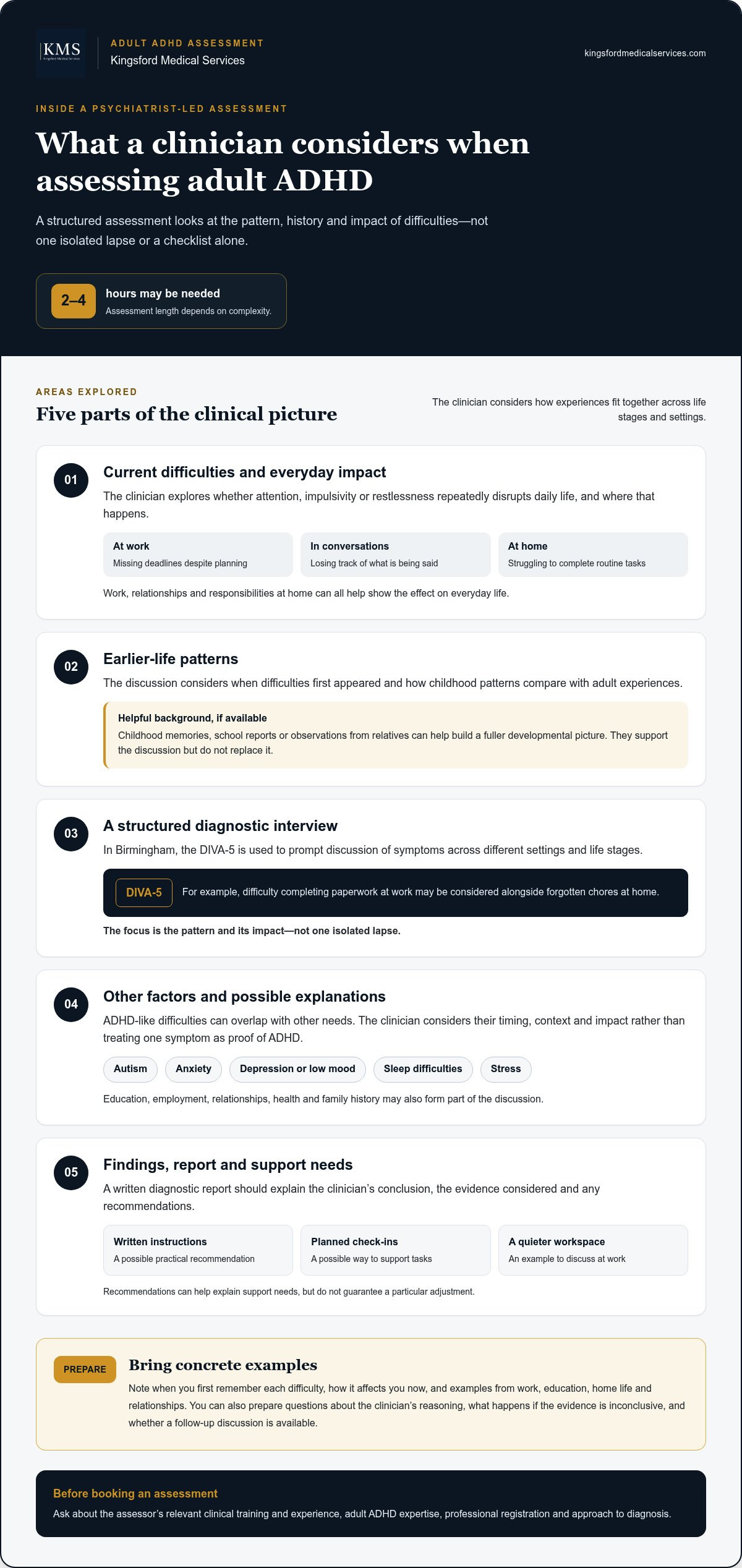
Consider an adult ADHD assessment when attention, impulsivity or restlessness repeatedly disrupts daily life. Examples include missing deadlines despite planning, losing track during conversations or struggling to complete routine tasks. A clinician considers how long these patterns have been present, where they occur and how they affect work, relationships and responsibilities at home.
Difficulties that began earlier in life can continue into adulthood, though changing responsibilities may make them more noticeable. Before an appointment, note specific examples from work, education, home life and relationships. Include when you first remember each difficulty and its current impact. Childhood memories, school reports or observations from relatives can help build a fuller developmental picture.
An assessment also considers overlapping needs. ADHD symptoms can occur alongside other neurodevelopmental difficulties or mental health concerns. Autism, anxiety, low mood or sleep difficulties may also affect concentration and daily functioning. A diagnostic interview explores the pattern, timing and impact of these experiences rather than treating one symptom as proof of ADHD.
A written diagnostic report should explain the clinician’s conclusion, the evidence considered and any recommendations. It can help you explain your needs to an employer, university or training provider. For example, a report might recommend written instructions, planned check-ins or a quieter workspace. These recommendations offer practical context, but do not guarantee a particular adjustment.
For support at work or in education, use the report as a starting point. Identify the task that causes difficulty, then connect it to a practical change. Someone who loses track of verbal instructions could request written follow-up. A student who struggles to organise coursework could discuss staged deadlines or planning support. Specific examples make these conversations more useful.
To find out how an NHS GP or local service will use a private diagnosis, give your GP the full report and ask how it may inform your care. The report should describe the assessment method, clinical reasoning and recommendations. Discuss proposed medication or shared-care arrangements directly, as ongoing NHS care involves its own clinical review.
Private assessment and medication treatment can carry risks if the evaluation is incomplete or treatment is unsuitable. ADHD symptoms can overlap with other mental health or neurodevelopmental difficulties, so a narrow assessment may miss important context. Medication can also cause unwanted effects and needs clinical oversight. Discuss your health history, current medicines and treatment concerns during appointments.
After diagnosis, support can address everyday strategies as well as clinical care. A written plan might set one priority, such as using reminders for appointments or breaking projects into smaller tasks. If autism and ADHD are both relevant, recommendations can address how their effects interact. Review the plan as your work, study or home responsibilities change.
Consider an assessment when persistent difficulties have a clear impact and you want a structured explanation. Before your appointment, prepare childhood examples, current challenges and questions about the diagnostic report. This helps the clinician build a fuller picture and gives you a more useful basis for discussing support at work, in education or after diagnosis.
Consultant psychiatrist-led diagnostic interviews
A consultant psychiatrist-led interview examines how attention, activity and impulse control affect adult life. The clinician explores examples from work, relationships and home routines, then compares them with childhood patterns. A structured approach helps distinguish persistent ADHD traits from difficulties linked to stress, mental health or another explanation.
In Birmingham, adult assessments use the DIVA-5, a structured diagnostic interview. It prompts discussion of symptoms across different settings and life stages. For instance, difficulty completing paperwork at work may be considered alongside forgotten chores at home. The interview examines the pattern and impact, not one isolated lapse.
A thorough appointment also explores education, employment, relationships, health and family history. Bring concrete examples, such as repeatedly missing deadlines or losing essential items. School reports or notes from someone who knew you as a child can help describe earlier behaviour. They support the discussion but do not replace it.
Ask about the assessor’s qualifications before booking. A suitable assessor should have relevant clinical training and experience assessing adult ADHD. If the assessor is a consultant psychiatrist, ask about their adult ADHD expertise, professional registration and approach to diagnosis. These details help you understand who will assess you and how they reach conclusions.
The assessment may also consider autism, anxiety, depression, sleep problems or other factors affecting concentration. These can overlap with ADHD symptoms, so the consultant considers their timing, context and impact. For example, concentration changes that began after a period of low mood may need a different interpretation from lifelong difficulties.
Appointments should leave time for questions about the findings and next steps. Ask how the consultant will explain their diagnostic reasoning, what happens if the evidence is inconclusive and whether a follow-up discussion is available. Clear answers help you understand the outcome, including whether further assessment or support may be appropriate.
Diagnosis and treatment are separate decisions. A consultant may discuss medication, including possible benefits, side effects and monitoring needs, but an interview does not automatically mean medication is suitable. Ask how treatment decisions relate to your health history and what clinical reviews involve.
Psychological therapy and coaching can address practical challenges alongside clinical care. Coaching, for example, may help organise tasks, while therapy can support work on emotional patterns or mental health concerns. Ask how each option relates to your assessment goals, and agree on a manageable first step for daily life.
Children’s ADHD assessments follow a different clinical pathway from adult interviews. If concerns involve a child as well as an adult, raise this separately rather than assuming one appointment covers both. For an adult assessment, prepare a brief timeline of symptoms, examples from different settings and questions about the consultant’s method.
Private assessment prices
Compare the assessment fee, what it includes, appointment timing and follow-up arrangements. In England, referral routes and shared-care arrangements can also affect the overall pathway.
Assessment costs and payment plans
A private assessment fee depends on the provider and scope of the service. Appointment format, assessment requirements and follow-up needs can shape the cost. Fees may cover the consultation, assessment and diagnostic report, while follow-up appointments and medication reviews may be charged separately.
Before committing, separate the initial diagnostic fee from later care. Note whether the assessment includes a report, a discussion of the findings and recommendations, then identify any separately charged follow-up appointments. This makes it easier to compare the complete pathway rather than focusing only on the first appointment.
If instalments are offered, compare the payment schedule, any credit terms and the total amount payable. Check how missed or cancelled appointments are handled, and whether a later medication review is included. These details matter for budgeting, particularly if you expect to need ongoing clinical reviews after diagnosis.
Comparing providers
Compare providers on three points: the total fee and included work, time to an appointment, and follow-up care. A lower initial fee may cover fewer steps, so assess the written report, feedback appointment and medication reviews as separate parts of the service.
Appointment timing affects when you can begin the diagnostic process, but not what happens afterwards. Ask how the provider communicates results, who discusses treatment options and how ongoing reviews are arranged. These details help you compare the full service, not just the earliest available appointment.
Shared care is separate from diagnosis. It describes an arrangement for ongoing prescribing and monitoring between clinicians; it should not be assumed to follow automatically from a private assessment. Clarify how any referral to your GP fits into the pathway, and how medication reviews would be managed if shared care is not agreed.
In England, NHS Right to Choose is a legal route through which a GP can refer a patient to an approved independent provider at no cost to the patient. It is distinct from paying privately. When comparing routes, consider referral eligibility, appointment timing and who is responsible for follow-up care.
Build a simple comparison using the same questions for each option: what does the assessment include, when can appointments begin, and what ongoing care is offered? Add report provision, medication follow-up and referral arrangements. This helps clarify the likely pathway before you decide, without treating the headline fee as the whole cost.
Adult ADHD assessment process
A specialist assessment combines questionnaires, a clinical interview and a review of your history. In the West Midlands, the assessment itself may take two to four hours, depending on complexity. These stages help the clinician consider both current difficulties and their developmental history.
Assessment stages
Adults attending an ADHD assessment are asked to complete five questionnaires. These help organise information about symptoms and their effects before the specialist interview. Prepare examples from work, home and relationships, along with relevant health and education records. A clear timeline can connect current difficulties with earlier experiences.
The clinician reviews your responses, history and daily functioning. Detailed ADHD assessments take 2.5-3 hours, and diagnostic assessments use DSM-5-TR criteria and the ICD-11 framework. The interview may explore other factors affecting attention, including sleep problems, mental health concerns or overlapping neurodevelopmental traits.
After the clinical discussion, the specialist explains the findings and diagnostic reasoning. If ADHD is diagnosed, the report can outline recommendations and possible next steps. If the evidence does not support a diagnosis, the discussion can still identify other factors that may explain the difficulties and guide further support.
Local waiting times
Private appointment timing depends on the provider’s diary, assessment format and time needed to review records. The wait for an appointment is separate from the assessment duration. Ask about the sequence of questionnaires, interview and report discussion when comparing pathways.
The estimated NHS waiting time for an adult ADHD assessment in the West Midlands is 7-12 months, as of July 2026. This estimate applies to the NHS route, not private appointments. Private scheduling depends on the provider’s appointment capacity and assessment arrangements.
Allow time to complete all five questionnaires and gather relevant records before the interview. A short timeline with examples from childhood and adult life can help keep the discussion focused. School reports or observations from relatives may also add useful context to your developmental history.
If medication is considered, assessment and prescribing are separate stages. Treatment decisions depend on clinical suitability, health history and monitoring needs. Stimulant medicines are controlled drugs and usually can only be prescribed for 30 days at a time. Discuss the prescribing process and review arrangements with the clinician.
Shared care involves ongoing responsibilities between clinicians, rather than automatic continuation of a private prescription. Adults on shared-care arrangements need a consultant review every 12 months to assess whether they remain suitable for medication. Include prescribing, monitoring and review arrangements in your planning, alongside the diagnostic appointment and report.
Before booking, map the process from first appointment to written outcome and any treatment discussion. Check how the assessment uses DSM-5-TR and ICD-11, what preparation is required, and how follow-up fits the pathway. These steps make the clinical stages and timing easier to understand.
Private adult ADHD assessment in Birmingham and the West Midlands
A private assessment for adult ADHD in the West Midlands can be arranged through local clinics or remote appointments. Check that the service assesses adults, explains its clinical process and provides a written outcome. Location is one practical factor; the assessment method and care after diagnosis matter too.
In Birmingham, one clinic’s adult service is for people aged 18 and over. Its assessment typically takes two to four hours, depending on complexity. Before booking, consider travel to an in-person appointment, access to video assessment and the time needed to complete forms or provide records.
Remote options vary by location. In the directory covered by the research, 157 clinics offer the whole assessment by video call, whilst no listed Stafford clinic offers the entire assessment that way. This distinction matters if you live outside Birmingham or have difficulty travelling. Ask how the interview and any later clinical reviews are delivered.
Stafford has two listed private clinics for adult ADHD assessment. Neither is marked as accepting NHS Right to Choose referrals. Across the wider West Midlands, six assessment providers accept these referrals. People registered with a GP in the region can use the scheme, which lets a GP refer to an approved independent provider at no cost to the patient.
Right to Choose and self-funded private care are different routes. For Right to Choose, discuss a referral with your GP and identify an approved provider accepting the scheme. For a private route, review the assessment scope, report arrangements and follow-up pathway before proceeding. This helps clarify which service you are choosing.
A private clinic can prescribe ADHD medication when prescribing is part of its service and the clinician considers treatment appropriate. Shared-care prescribing through the NHS is not automatic after a private diagnosis. Discuss the arrangement with the clinicians involved; adults on shared-care arrangements need a consultant review every 12 months to assess continued suitability for medication.
Medication planning also involves monitoring, prescription arrangements and review appointments. Stimulant medicines are controlled drugs and usually can only be prescribed for 30 days at a time, according to clinical guidelines. Ask how titration is managed, who reviews treatment and what happens if shared care is not arranged.
For a local decision, compare travel, assessment format, clinical process and follow-up responsibilities. A Birmingham appointment may suit someone who prefers face-to-face discussion, while video can help reduce travel where offered. For information about psychiatry support options, explore the available clinical care pathways.
Kingsford Medical Services: Respiratory & Sleep Medicine Consultations
Kingsford Medical Services offers Psychiatry Services for people seeking clinical support with mental health concerns. If you’re considering an ADHD assessment, this service provides a relevant route to discuss your concerns and support needs. Bring examples of how attention, organisation or impulsivity affect everyday life, along with questions about assessment and next steps.
Sleep difficulties can also affect daily wellbeing. If sleep or respiratory symptoms are part of your wider health picture, Respiratory & Sleep Medicine Consultations offer a separate way to discuss those concerns. The appropriate service depends on what you need help with.
For a calm starting point, contact Kingsford Medical Services to discuss your care needs.
Take a considered next step
Choosing a private assessment for adult ADHD in the West Midlands can be a meaningful step towards understanding patterns affecting work, relationships or daily routines. Before proceeding, note the questions you want answered and the support that would make a practical difference. A clear starting point helps you explain your priorities and consider what care should look like next.
Kingsford Medical Services offers Private GP Appointments, Respiratory & Sleep Medicine Consultations and Paediatric Services. These services support different healthcare needs, including concerns affecting adults, sleep and children. The appropriate route depends on the issue you want to discuss.
If you’d like to discuss your healthcare needs, contact Kingsford Medical Services. Taking the next step at your own pace can help you move forward with greater clarity.
Frequently Asked Questions
Which private clinics assess adult ADHD in the West Midlands?
Private adult ADHD assessments are available in Birmingham and Stafford, and Kingsford Medical Services in Knowle, Solihull, offers adult ADHD assessments through its psychiatry service. When comparing options, consider whether the clinic assesses adults, how it gathers developmental history and what happens after diagnosis. Ask how you’ll receive the outcome and whether follow-up care is part of the pathway, particularly if you live outside Birmingham.
What is the cost of a private adult ADHD assessment in the West Midlands?
Costs vary according to the provider and what the assessment includes. Compare the consultation, written report and feedback arrangements, then check whether follow-up appointments or medication reviews are charged separately. If you’re considering care in Knowle, Solihull or Birmingham, review the full cost structure before booking so you can distinguish the diagnostic assessment from ongoing clinical care.
What does an adult ADHD assessment involve, and how many appointments are needed?
An assessment usually combines preparation, a detailed clinical interview and discussion of the findings. Patients complete five questionnaires, and a structured interview such as the DIVA-5 can help the psychiatrist explore symptoms across life stages. The diagnostic interview is typically the central appointment; feedback or treatment reviews may be separate. Ask how the provider organises these stages, as the appointment count depends on the pathway and follow-up required.
What is the process for booking a private adult ADHD assessment in the West Midlands?
Start by contacting a clinic that assesses adults, then ask about its booking steps, assessment format and preparation requirements. Gather examples of difficulties from different settings and any relevant childhood records before your appointment. If you’re weighing private care against NHS Right to Choose in England, discuss the referral route with your GP. Kingsford Medical Services provides adult ADHD assessments through its psychiatry service in Knowle, Solihull.



Comments