
Musculoskeletal Assessment in the West Midlands: What to Expect
If you have persistent pain or restricted movement, it can be hard to know whether to see a GP, a physiotherapist or an MSK clinician. A musculoskeletal assessment West Midlands patients can access through Kingsford Medical Services gives you the opportunity to discuss your symptoms with a clinician and consider an appropriate next step.
At the Knowle clinic, Dr Shahid Malik is a GP with an interest in MSK medicine, and physiotherapy is available. These services have different roles, and not everyone needs both. The right route depends on your symptoms and individual assessment. This guide explains what an appointment may involve, including questions about your health and daily activities, relevant physical checks and discussion of the findings. It also explains when symptoms need urgent attention rather than a routine appointment, and how private care can complement your NHS GP. Kingsford Medical Services serves patients in Knowle and Solihull, as well as Birmingham, Nuneaton and the wider West Midlands.
Table of Contents
What does a musculoskeletal assessment in the West Midlands involve?
How does a musculoskeletal assessment work, from symptoms to clinical findings?
Private or NHS musculoskeletal assessment: how do the routes differ?
How can you prepare for a musculoskeletal assessment in the West Midlands?
Access MSK assessment and physiotherapy at Kingsford Medical Services
What does a musculoskeletal assessment in the West Midlands involve?
A musculoskeletal assessment is a structured clinical review of symptoms affecting the bones, joints, muscles and other soft tissues. The clinician discusses what you are experiencing, considers how it affects your movement and everyday activities, and agrees a proportionate next step with you. This may involve advice, further assessment or discussion of suitable care. An assessment does not automatically lead to a diagnosis, imaging or a particular treatment.
MSK symptoms can affect different parts of the body and have different causes. The general overview of musculoskeletal disorders describes this broad range of problems, but similar symptoms do not always have the same explanation. An individual assessment gives the clinician a chance to consider your circumstances rather than draw conclusions from one symptom alone.
Regional figures provide context, not a prediction about any one person. The UK Government’s Fingertips public health profiles reported that 20.5% of people aged 16 and over in the West Midlands reported a long-term musculoskeletal problem in 2023. This population-level figure cannot identify the cause of your pain or indicate which care you need. A musculoskeletal assessment West Midlands patients seek focuses on their own symptoms and how these affect function.
Which parts of the body and symptoms can an MSK assessment cover?
An assessment may cover back or neck pain, a sore shoulder or knee, or muscle symptoms. You may also want to discuss stiffness, weakness or reduced movement. Because these symptoms can have different causes, the clinician will ask when they began, what affects them and how they interfere with tasks such as walking, lifting or getting dressed. The questions and areas examined are tailored to your concerns, rather than following one fixed checklist.
When should symptoms receive urgent attention?
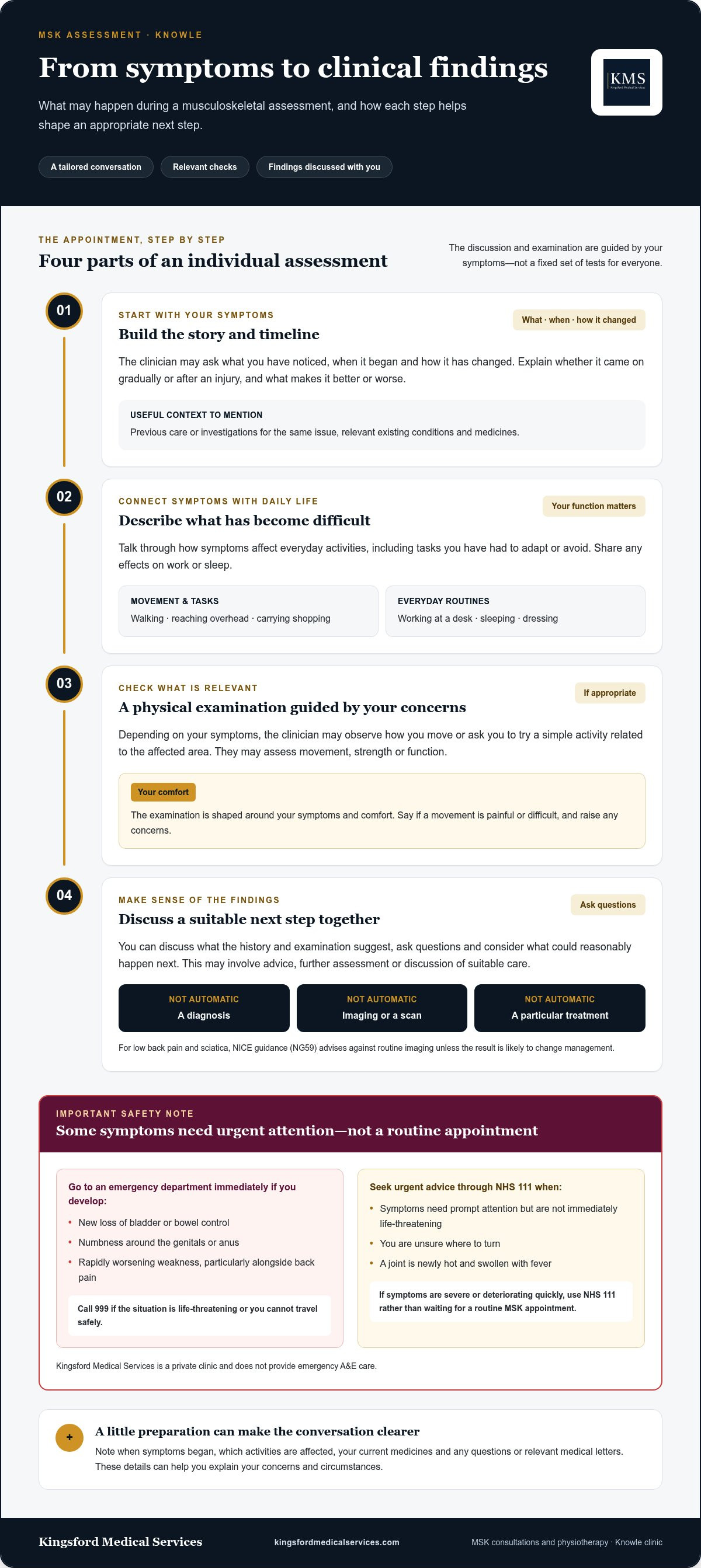
A routine appointment may be suitable for ongoing discomfort or stiffness that is not rapidly worsening. Do not wait for one if you develop new loss of bladder or bowel control, numbness around the genitals or anus, or rapidly worsening weakness, particularly alongside back pain. These symptoms can indicate a serious problem that needs emergency assessment. Go to an emergency department immediately. Call 999 if the situation is life-threatening or you cannot travel safely.
Seek urgent advice through NHS 111 if your symptoms need prompt attention but are not immediately life-threatening, or if you are unsure where to turn. For example, a newly hot, swollen joint with fever needs urgent medical advice. If symptoms are severe or deteriorating quickly, use NHS 111 rather than waiting for a routine MSK appointment. Kingsford Medical Services is a private clinic and does not provide emergency A&E care.
An assessment does not mean that you will automatically have a scan. For low back pain and sciatica, NICE guidance (NG59) advises against routine imaging unless the result is likely to change management. A clinician considers your history and examination findings when deciding whether investigation or another step is appropriate. The aim is an individual plan, not testing or treatment by default.
How does a musculoskeletal assessment work, from symptoms to clinical findings?
An assessment is a conversation and examination shaped around your needs, not a standard set of tests for everyone. The clinician considers your symptoms alongside your health and circumstances, then explains what the findings may mean and what could reasonably happen next. Knowing the usual steps can help you feel prepared.
Symptom history: The clinician will ask what you have noticed, when it began and how it has changed. Whether symptoms came on gradually or after an injury, and what makes them better or worse, can help put the problem in context.
Functional impact: You will discuss how symptoms affect everyday activities. This might include walking, reaching overhead, working at a desk, sleeping or carrying shopping. Choose examples that show what has become difficult for you.
Relevant examination: If appropriate, the clinician may observe how you move and assess strength or function related to the area you have described. The examination is guided by your symptoms and comfort.
Discussion of findings: You can discuss what the history and examination suggest, ask questions and consider a suitable next step. Further investigation or a particular treatment is not automatic.
What questions may a clinician ask about your symptoms?
Think about when the problem started, whether it has changed and what affects it. You may be asked whether a particular movement, activity or time of day makes symptoms better or worse. Describe tasks you have had to adapt or avoid, and any effect on work or sleep. If you have received previous care or investigations for the same issue, explain what happened and whether it helped. Mention relevant existing conditions and medicines as well. This context helps the clinician consider your symptoms as a whole, rather than relying on one feature in isolation.
What may happen during a physical examination?
The clinician may ask you to move the affected area or try a simple activity relevant to your concern. Depending on your symptoms, they might assess movement, strength or how comfortably you manage a functional task. Explain if a movement is painful or difficult, and raise any concerns before or during the examination. The approach should be adapted to your symptoms and comfort. No single test is necessary for every person, and an examination does not mean imaging will follow or guarantee a particular diagnosis.
History and examination together help the clinician understand the problem and guide a proportionate next step, rather than relying on a symptom or test result alone. Depending on your circumstances, the findings may lead to advice, further clinical review or a discussion about care options.
Kingsford Medical Services provides a musculoskeletal assessment West Midlands patients can access at its Knowle clinic. The team includes Dr Shahid Malik, a GP with an interest in MSK medicine, and the clinic also provides physiotherapy. You can explore clinician-led care at Kingsford Medical Services as a private option that complements your NHS GP care.
Private or NHS musculoskeletal assessment: how do the routes differ?
Both private and NHS routes can help you discuss MSK symptoms with a clinician, but access arrangements and how care is organised vary. Community services may have their own eligibility criteria and referral processes. In some areas, self-referral is possible; elsewhere, a GP referral or another route may apply. NHS pathways are not identical across the West Midlands, so the route depends on the service and your circumstances.
This comparison describes broad differences, not a guarantee of what any individual service will provide. The right route depends on your symptoms, local NHS arrangements and personal circumstances. Private care complements, rather than replaces, your NHS GP relationship.
When might a private MSK consultation suit your circumstances?
A private consultation may suit you if you want another route to discuss symptoms with a clinician. At Kingsford Medical Services in Knowle, Solihull, Dr Shahid Malik is a GP with an interest in MSK medicine, and the clinic provides physiotherapy. The services have distinct roles: an MSK consultation helps you discuss symptoms and consider possible next steps, while physiotherapy provides physiotherapy care. Not every patient needs both, and an assessment does not guarantee a particular treatment or onward referral.
For people considering a musculoskeletal assessment West Midlands option, the consultation provides a private setting to discuss concerns and understand what may be appropriate. The outcome depends on the clinician’s assessment, not simply on the route you choose.
How can private and NHS care work alongside one another?
If you have already received care for the same concern, sharing relevant information can help the clinician understand the full picture. Bring or describe previous letters, investigation results, medicines and treatments, including what has or has not helped. You can also explain whether you are currently receiving NHS care for the same issue.
With that context, the clinician can discuss findings and suitable next steps in light of your circumstances. Private care at Kingsford Medical Services complements NHS GP services; it does not replace them. Keeping your NHS GP informed, where appropriate, can support continuity across the care you receive.
How can you prepare for a musculoskeletal assessment in the West Midlands?
A little preparation can help you explain what has changed and what you need support with. You do not need to arrive with a diagnosis or a complete medical timeline. A few clear notes can help you make good use of your appointment, especially if pain or limited movement makes it difficult to recall details on the spot.
What information should you bring to an MSK appointment?
Before your appointment, jot down the details that best describe your experience. Focus on what happens in daily life rather than trying to interpret the symptoms yourself.
Symptom timeline: Note where you feel discomfort, when it began and whether it has changed. Include any relevant injury or event if you remember one.
Triggers and relief: Record movements or activities that seem to worsen or ease symptoms. Do not deliberately repeat a painful movement to test it.
Functional impact: Give specific examples, such as difficulty reaching a shelf, walking to the shops, sitting through work or getting comfortable at night. These details show how symptoms affect you.
Relevant health information: List current medicines, existing conditions, previous treatment and related investigations. Bring relevant letters or test results if you have them.
If you are unsure whether a detail matters, include it in your notes and raise it during the consultation. Changes over time can be useful too. For instance, note whether a task has become harder or the affected area feels different from when symptoms first appeared.
What questions can help you leave with a clear plan?
It is reasonable to ask for the findings to be explained in plain language. Consider writing your questions down beforehand so you can return to them during the discussion. You might ask:
What do the assessment findings suggest, and what remains uncertain?
What next steps may be appropriate for my circumstances?
Should I expect a review, and what changes should prompt me to seek further help?
Also mention concerns that affect your priorities, such as managing work, sleep, mobility or caring responsibilities. The more clearly the clinician understands what you need to do each day, the more relevant the discussion can be. You do not need to minimise the impact because a symptom seems small or intermittent.
Preparation can help for both an in-person appointment and an e-consultation, but the format affects what can be assessed. At an in-person appointment, a clinician may be able to observe relevant movement directly. A remote discussion can still help you describe your symptoms and circumstances, but examination options are not necessarily identical. Follow your appointment instructions and keep your notes nearby.
For a musculoskeletal assessment West Midlands patients can access at Kingsford Medical Services, bring information that helps explain your situation and raise your concerns openly. Read about clinician-led MSK care at the private clinic in Knowle, Solihull, serving the wider West Midlands.
Access MSK assessment and physiotherapy at Kingsford Medical Services
Kingsford Medical Services is a private clinic in Knowle, Solihull, serving patients across Birmingham, Nuneaton and the wider West Midlands. The clinic provides clinician-led consultations to discuss symptoms and consider an appropriate next step. Same-day and next-day GP appointments are available, while specialist consultations aim for appointments within the same week. The suitable appointment depends on your needs and the type of care you are seeking.
What MSK-related care is available at the Knowle clinic?
Dr Shahid Malik is a GP with an interest in MSK medicine. The clinic provides MSK consultations where you can discuss symptoms, relevant health history and concerns, then consider what may be appropriate in your circumstances. A consultation does not mean every patient will need a particular investigation, treatment or onward referral.
The clinic also provides physiotherapy, which has a distinct role. Physiotherapy focuses on physiotherapy care, while an MSK medicine consultation offers a clinician-led opportunity to discuss symptoms and possible next steps. They are not interchangeable, and not everyone needs both. The clinician can consider your situation and discuss which route may be suitable.
For broader context about private GP consultations and personalised care in the area, the private GP care guide for Solihull explains more about that approach.
How can you arrange a consultation in Knowle?
Kingsford Medical Services offers in-person appointments and e-consultations. The suitable format depends on what you need to discuss. A remote consultation may be useful for talking through symptoms, while an in-person appointment lets the clinician meet with you at the clinic. Assessment and examination options can differ by format, so the clinician will consider what is appropriate for your circumstances.
The clinic is at 6 Wilsons Road, Knowle, B93 0HZ. When booking a musculoskeletal assessment West Midlands patients can access through private care, explain your main concern and share any relevant history. Kingsford Medical Services complements NHS GP care and supports your existing relationship with your NHS GP. Relevant letters, test results and treatment history can provide useful context for the consultation.
To explore the clinic’s services and arrange an appropriate consultation, visit Kingsford Medical Services.
Take the next step with confidence
Pain or restricted movement can leave you unsure whether to wait, seek advice or change your routine. You do not need to work out the cause alone. A clinician-led conversation can help you make sense of what you are experiencing and consider a sensible way forward based on your needs, rather than assumptions.
If you are considering a musculoskeletal assessment West Midlands patients can access privately, Kingsford Medical Services offers a way to discuss your concerns. Its care complements your NHS GP relationship, so you can keep your usual care team informed and share relevant information where appropriate.
A consultation can be a practical next step towards clearer guidance. Explore Kingsford Medical Services and arrange a consultation.
Frequently Asked Questions
What is included in a musculoskeletal assessment?
A musculoskeletal assessment usually includes a discussion of your symptoms and relevant health history, followed by checks guided by the problem you describe. If reaching overhead is difficult, for example, the clinician may focus on shoulder movement and how it affects that task. You do not need to arrive with a diagnosis. Explain what you are finding hard, and the clinician can decide which areas need attention.
Can I get a private musculoskeletal assessment in the West Midlands?
Yes. Kingsford Medical Services is a private clinic in Knowle, Solihull, serving patients across Birmingham, Nuneaton and the wider West Midlands. A musculoskeletal assessment West Midlands patients seek provides an opportunity to discuss concerns with a clinician. Dr Shahid Malik is a GP with an interest in MSK medicine, and the clinic provides physiotherapy and specialist consultations. Private appointments complement NHS GP care rather than replacing it.
Is a musculoskeletal assessment the same as physiotherapy?
No. An assessment is a clinical process for considering symptoms and discussing an appropriate next step. Physiotherapy is a distinct service focused on physiotherapy care. Someone may first want to discuss persistent symptoms with a clinician, while another person may already have a clear plan and be seeking physiotherapy. Whether one or both are suitable depends on individual circumstances.
How long does a musculoskeletal assessment take?
There is no single appointment length for every type of MSK assessment. At Kingsford Medical Services, routine GP appointments and GP e-consultations are 20 minutes. That duration applies to those GP appointments, not automatically to physiotherapy or specialist consultations. The time needed depends on the appointment type and what you need to discuss, so prepare your main concern and key questions to keep the conversation focused.
Do I need a GP referral for a private MSK consultation?
You do not need to register with Kingsford Medical Services to book a one-off private GP appointment. A GP consultation is a direct way to discuss symptoms and consider what may be appropriate. Specialist consultation routes can differ according to the service and clinical circumstances, so GP and specialist consultations should not be assumed to have identical referral arrangements.
What should I wear to a musculoskeletal assessment?
Choose comfortable clothing that lets you move easily and makes it practical to show the area causing concern, such as your knee or shoulder. For a knee problem, trousers that can be comfortably adjusted may be more convenient than restrictive clothing. You do not need specialist sportswear. For a remote appointment, wear something that lets you describe or show movement safely without straining.
When should I seek urgent help for muscle or joint pain?
Seek urgent advice if pain follows a serious injury, you cannot use or put weight on the affected area, or symptoms worsen rapidly. Contact NHS 111 for urgent help that is not immediately life-threatening. Call 999 if someone is seriously unwell or in immediate danger. A routine private appointment is not a substitute for emergency care; Kingsford Medical Services does not provide emergency A&E services.



Comments