
Pre-employment health screening in the West Midlands: an employer’s guide
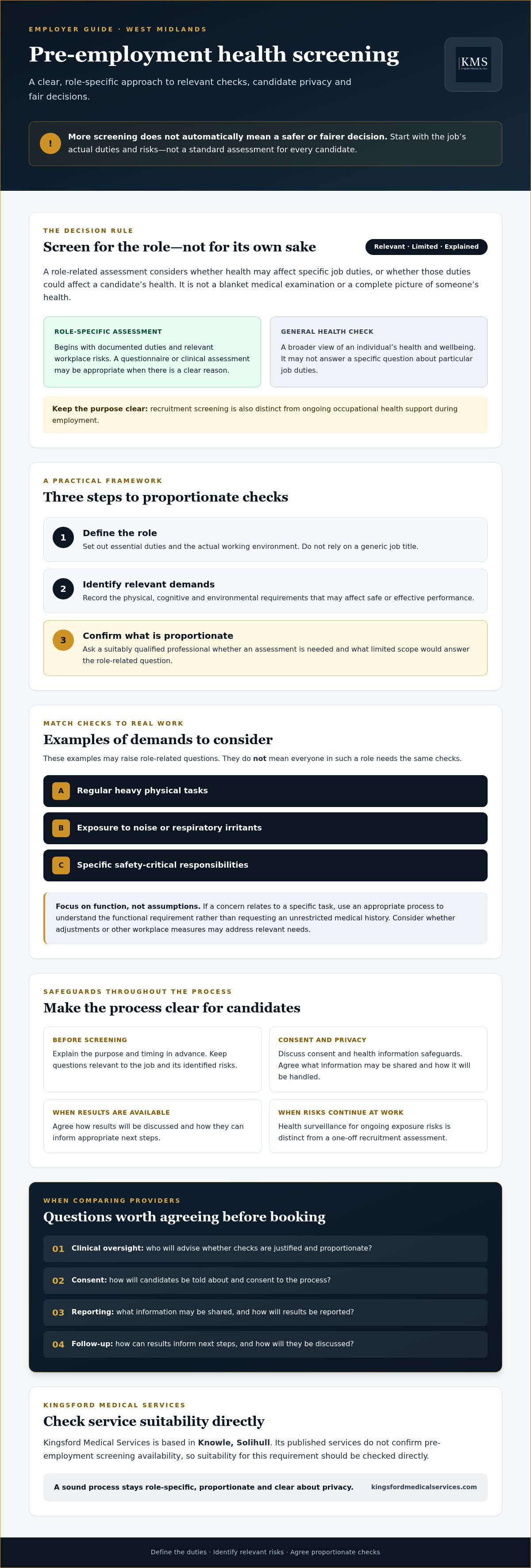
More screening does not automatically mean a safer or fairer hiring decision. Choosing pre-employment health screening West Midlands employers can use effectively starts with the role: a check should relate to its genuine duties and risks, rather than applying the same assessment to every candidate. Employers need confidence in a new hire while also taking care with privacy, consent and health information.
It can be difficult to identify the right approach, particularly when occupational health screening is confused with a general health check. This guide explains how to compare screening options, choose proportionate checks and discuss safeguards with a provider. It covers consent, what information may be shared, how results can inform next steps and what to ask before booking. The aim is a clear, role-specific process that supports sound decisions without requesting more medical information than the situation requires.
Table of Contents
What does pre-employment health screening in the West Midlands involve?
How should employers choose proportionate pre-employment health screening?
What should employers compare when selecting a West Midlands screening provider?
How can you prepare candidates and manage screening results fairly?
Finding pre-employment health screening support in the West Midlands
What does pre-employment health screening in the West Midlands involve?
Pre-employment health screening is a role-related assessment of whether a candidate’s health may affect their ability to carry out specific job duties, or whether those duties could affect their health. It should reflect the job and its relevant workplace risks, not function as a blanket medical examination for every candidate.
The process might involve a health questionnaire or, where there is a clear reason, a clinical assessment. Agree the purpose with the clinician before screening begins. This helps keep the questions relevant to the work, rather than gathering general medical details without a clear use. A pre-employment physical examination is one possible form of assessment, but it isn’t automatically appropriate for every role.
Which roles may need a health assessment?
Health information may be relevant when particular duties or exposures need to be considered. For example, regular heavy physical tasks, exposure to noise or respiratory irritants, or specific safety-critical responsibilities may raise questions about the demands of a job. These examples don’t mean that everyone in such a role needs the same checks. Any assessment should reflect the actual tasks, environment and risks.
Before arranging screening, describe the role accurately and ask a competent occupational health professional what, if anything, is justified. This keeps questions focused and supports consideration of suitable adjustments, rather than treating a diagnosis alone as a reason to exclude someone.
What is the difference between screening and a health check?
A general health check is usually intended to give an individual a broader picture of their health. It may support personal wellbeing, but it might not answer a specific question about whether a candidate can carry out particular duties safely. A role-specific assessment, in turn, isn’t intended to provide a complete overview of someone’s health.
The screening should follow the purpose agreed between the employer and clinician. It might be limited to reviewing relevant information, or include further assessment if there is a clear role-related reason. Pre-employment screening also differs from ongoing occupational health support, which may address health and workplace issues during employment rather than at recruitment.
For a separate overview of general wellbeing assessments, see this private health check guide. It covers a distinct service topic, not a substitute for deciding what a particular role requires.
For employers considering pre-employment health screening West Midlands providers, don’t start with a standard package. Define the duties and relevant risks first, then confirm with an appropriately experienced professional whether screening is needed and what proportionate scope would meet its purpose.
How should employers choose proportionate pre-employment health screening?
A proportionate process starts with the job, not a candidate’s diagnosis or medical history. Link screening to the post’s documented duties and risks, and collect only information needed for a defined purpose. This helps avoid broad, speculative questions and keeps attention on whether relevant needs can be addressed through adjustments or other workplace measures.
Use this three-step framework:
Define the role. Set out the essential duties and actual working environment, rather than relying on a generic job title.
Identify relevant demands. Record the physical, cognitive and environmental requirements that may affect safe or effective performance.
Confirm proportionate checks. Ask a suitably qualified professional whether assessment is needed and what limited scope would answer the role-related question.
Separate essential information from questions that are simply broad or convenient. If a concern relates to a specific task, for example, ask about the functional requirement through an appropriate process rather than requesting an unrestricted medical history. For ongoing exposure risks, consult the HSE health surveillance guidance. Health surveillance during employment is distinct from a one-off recruitment assessment.
How do job duties shape the checks required?
Document the demands of the specific post before deciding whether to screen. Consider the tasks, working environment and any relevant risk assessment. A check should address an identified requirement, not gather health details without a clear purpose. If duties are complex or the risk assessment raises clinical questions, seek advice from a qualified occupational health professional before setting the scope.
When should employers seek specialist advice?
Seek specialist input if a role involves safety-critical duties, unusual workplace exposures or uncertainty about which assessment is suitable. A checklist can help organise decisions, but it can’t replace individual clinical or legal advice. Before setting requirements, verify current professional guidance and obtain appropriate advice on how the Equality Act 2010 applies to the role and any relevant exceptions. Don’t assume a particular condition rules out a candidate. Consider the role’s actual requirements and possible adjustments.
For employers arranging pre-employment health screening West Midlands, keep a written rationale: note the job requirement, why information is needed and how the result will inform a fair decision. Kingsford Medical Services is a private clinic in Knowle, Solihull, serving the wider West Midlands. Its published services don’t confirm employer screening, so employers can contact Kingsford Medical Services to clarify whether its services are suitable before making arrangements.
What should employers compare when selecting a West Midlands screening provider?
A provider should explain how its assessment answers the role-related question you have identified. A generic health check may provide useful information about someone’s overall wellbeing, but it may not establish whether they can meet a specific job requirement or whether adjustments could help. Before commissioning pre-employment health screening West Midlands, compare the clinical scope and safeguards, not just convenience.
Use these points to structure a provider discussion:
Which questions should employers ask a screening provider?
Ask the provider to describe the assessment in plain terms, identify who will conduct it and explain the relevant clinical expertise. Confirm whether the process is designed to answer your specific fitness-related question, rather than provide a broad wellness overview. Before commissioning the service, discuss how candidate queries, any recommended further assessment and potential adjustments will be managed.
How should employers assess privacy and reporting arrangements?
Ask how consent is recorded, who can access health information, how it is stored securely and how long it is retained. Clarify what information is shared with the employer and what remains in clinical records. Verify current Information Commissioner’s Office (ICO) guidance and applicable data protection requirements for your circumstances, rather than relying on general assurances.
A useful report should communicate the conclusion relevant to the work and any appropriate recommendations, without disclosing unnecessary clinical detail. Agree the reporting format and information flow in advance so the candidate understands what may be shared and why.
Check provider credentials and experience against the role being assessed. Kingsford Medical Services is based in Knowle, Solihull, and serves the wider West Midlands, including employers in Birmingham and Nuneaton. Its published services don’t confirm employer-focused screening, occupational health reports or fitness-for-work assessments. Clarify the clinic’s scope, reporting arrangements and suitability directly before considering any service.
How can you prepare candidates and manage screening results fairly?
A clear process helps candidates understand what to expect and gives employers a sound basis for considering the outcome. Explain the assessment in neutral, practical terms. Avoid implying that it guarantees a particular result or that a health condition automatically means someone cannot do the job.
What should candidates know before an appointment?
Tell candidates why the assessment has been requested, what it is intended to establish and how it relates to the role. Give them enough notice to ask questions or discuss access needs, including whether reasonable adjustments to the appointment may help. Ask the provider what information or documents the candidate should bring, rather than leaving them to guess.
A short preparation checklist can cover:
Purpose: why the assessment is relevant to the role and what it will consider.
Timing and arrangements: when and how the appointment will take place, including any preparation instructions provided by the clinic.
Contact details: who the candidate can contact with questions, access needs or concerns.
Information sharing: what the provider may report to the employer, and how the candidate can ask for clarification.
Calm, straightforward communication can reduce uncertainty without suggesting that the outcome is predetermined. Candidates should have a clear route to raise concerns privately.
What should employers do after receiving a report?
Read the report in context. Consider its advice against the actual requirements of the post, and don’t treat a clinical finding as an automatic reason to reject a candidate. If the report identifies a relevant limitation or recommends further discussion, seek appropriate clinical advice and consider whether adjustments could address the issue before reaching a decision.
Limit access to health information to people who need it for an appropriate purpose. Where practicable, keep clinical detail separate from routine recruitment records, and verify current Information Commissioner’s Office guidance and applicable data protection requirements for your organisation. If a finding is complex, ask the clinician to explain its relevance to the role rather than drawing conclusions from a diagnosis alone.
For employers considering pre-employment health screening West Midlands, agree in advance how questions, further assessment and possible adjustments will be handled. Kingsford Medical Services is a private clinic in Knowle, Solihull, but its published services don’t confirm employer-focused screening or occupational health reports. Contact Kingsford Medical Services to ask whether its services are suitable before making arrangements.
Finding pre-employment health screening support in the West Midlands
Local access is only one part of choosing a provider. Before booking, check that the service matches the assessment you need, how appointments are delivered and how results or questions will be communicated. For pre-employment health screening West Midlands, confirm that the provider can address your role-specific requirements. Don’t assume a general medical appointment will produce an occupational health opinion.
What should West Midlands employers confirm before enquiring?
Be ready to describe the role, the reason for assessment and the specific question you need answered. Then check directly with each provider:
Service scope: Do they offer the employer-focused assessment you require, and what does it cover?
Location and format: Where would an appointment take place, and is the proposed format suitable for the assessment?
Process: What happens before, during and after the appointment, and what information should the candidate provide?
Reporting: Can the provider explain whether an employer report is available, what it may contain and how consent and communication are handled?
Confirm expected timescales with the provider rather than relying on assumptions. Kingsford Medical Services is a private clinic in Knowle, Solihull, serving the wider West Midlands, including Birmingham and Nuneaton. It offers private GP appointments, health checks and diagnostic services. However, its published services don’t confirm pre-employment screening, occupational health reports or fitness-for-work assessments. Check whether the clinic can meet your specific requirements before making plans.
When might a private GP consultation be relevant?
A private GP appointment may be appropriate for an individual’s clinical concern, but it isn’t automatically an occupational health assessment or a report on fitness for a particular job. Make the purpose, scope and intended recipient of any information clear before arranging an appointment. For general information about private GP care, read the private GP care guide.
If you’re considering Kingsford Medical Services, first confirm the service scope, appointment format and any reporting arrangements relevant to your enquiry. Contact Kingsford Medical Services to discuss whether its services are suitable for your needs.
Make your next screening decision with confidence
A fair process starts with the role. Define its genuine duties and risks, then choose only checks that serve a clear purpose. Before booking, confirm the provider’s clinical expertise, assessment scope, consent process and reporting arrangements. Clear communication with candidates and careful interpretation of findings help keep decisions focused on role requirements rather than assumptions about health.
If you’re considering pre-employment health screening West Midlands, verify that the provider can deliver the specific employer-focused assessment you need. Kingsford Medical Services is based in Knowle, Solihull, and serves the wider West Midlands. The practice is led by GMC-registered clinicians and operates seven days a week, but its published services don’t confirm pre-employment screening, occupational health reports or fitness-for-work assessments. Contact the clinic to establish whether these details are relevant to your enquiry.
Contact Kingsford Medical Services to discuss your requirements and clarify whether its services are suitable. With the right questions and a proportionate approach, you can build a screening process that is clear, considered and respectful of candidates.
Frequently Asked Questions
What does pre-employment health screening involve?
Pre-employment health screening is an assessment linked to a job’s duties and relevant workplace risks. It may involve a health questionnaire or, where justified, a clinical assessment. The aim is to consider whether a health-related factor affects a specific requirement, or whether an adjustment may help. It isn’t necessarily a full medical examination, and the checks should have a clear purpose agreed by the employer and clinician.
Is pre-employment health screening required for every job?
No. A health assessment isn’t a standard requirement for every role. Employers should consider whether the job’s actual duties, working environment or identified risks make screening relevant, then seek suitable professional advice if the scope is unclear. A blanket assessment can collect information that has no clear connection to the work. The decision should be role-specific, proportionate and consistent with current legal and professional guidance.
Can an employer ask health questions before offering a job?
There are legal limits on asking about health or disability before offering employment in the UK, although specific exceptions may apply. Employers should check current Equality Act 2010 guidance and obtain legal advice before including health questions in recruitment. Questions should have a lawful, role-related purpose and must not be used to make assumptions about a candidate’s suitability. If screening is planned, explain its purpose and timing clearly.
When should pre-employment health screening take place?
Screening is commonly arranged after a conditional job offer, but the appropriate timing depends on the role, the reason for assessment and applicable legal requirements. Verify the process before inviting a candidate to screening, especially if you’re unsure whether a question or check is permitted earlier. Explain the expected stages, allow time for candidates to raise access needs and don’t imply that an appointment guarantees a particular recruitment outcome.
What information can an employer receive from a screening provider?
An employer should agree reporting arrangements with the provider and candidate in advance. A report may communicate a conclusion relevant to the role, such as whether further discussion or consideration of adjustments is recommended. It shouldn’t automatically disclose detailed medical information that isn’t needed for that purpose. Clarify what the provider will share, how consent is handled and who can access the report, then check current data protection guidance.
How much does pre-employment health screening cost?
As an indicative regional range, pre-placement screening in the West Midlands was reported at £50 to £300 per candidate in September 2026. The scope affects the fee: a questionnaire review may cost less than a detailed assessment. This is not a Kingsford Medical Services price or quote. Employers in Knowle, Solihull, Birmingham and Nuneaton should request a provider’s current costs and confirm exactly what the assessment includes.
Can a candidate be rejected because of a health condition?
A health condition shouldn’t automatically lead to rejection. Employers should consider the actual requirements of the role, relevant clinical advice and whether reasonable adjustments could enable the candidate to do the work. Decisions involving health or disability can raise complex legal issues, including under the Equality Act 2010, so verify current requirements and seek qualified advice before acting. Focus on relevant evidence and avoid assumptions based on a diagnosis alone.



Comments