
Developmental assessments for children in the West Midlands
A developmental assessment for a child in the West Midlands may be appropriate when concerns about their development call for a closer look at their needs and progress. Birmingham has four Child Development Centres, and their referral criteria include children under 5 who attend pre-school provision when the centre can demonstrate added value. An assessment may consider areas such as communication, learning, behaviour and social development, including concerns about autism or ADHD.
It’s understandable to wonder whether a child’s differences are part of their individual development or a sign they may benefit from further support. Noticing a concern does not mean jumping to a diagnosis. It can be the first step towards understanding what might help.
This article explains who may need a Child Development Centre assessment, which signs can prompt one, and what developmental needs may be explored. It also outlines what an assessment can involve, so you can approach the next steps with greater clarity.
Table of Contents
Conditions assessed, including autism and ADHD
In the West Midlands, NHS developmental assessments may involve local Child Development Centres and paediatric services. Birmingham has four Child Development Centres. Depending on a child’s needs and referral pathway, the team may include paediatricians, psychologists, speech therapists and occupational therapists. These services can assess autism, ADHD, speech delay and broader developmental concerns.
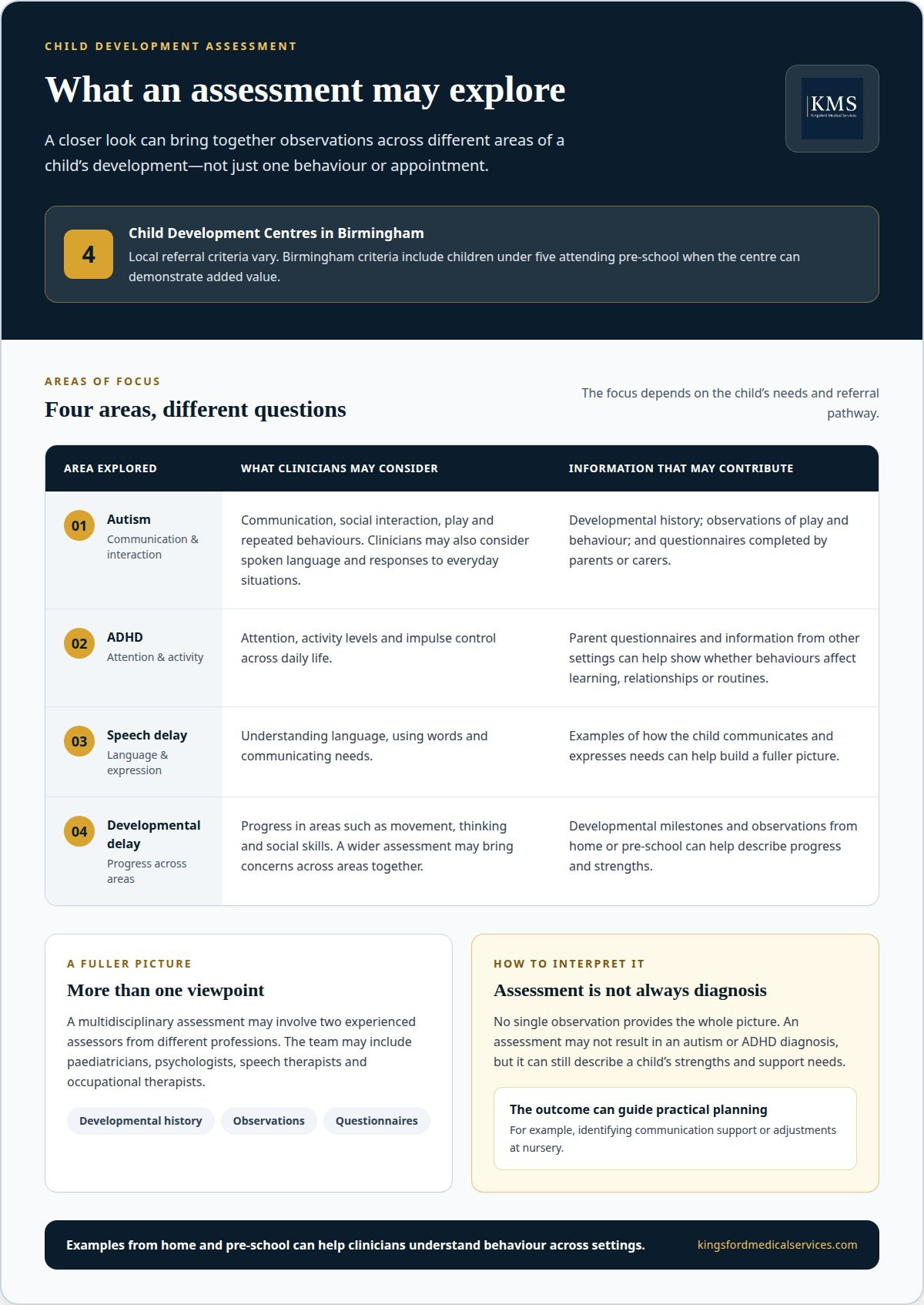
An autism assessment explores how a child communicates, interacts and responds to everyday situations. Clinicians may consider developmental history, observations of play and behaviour, and questionnaires completed by parents or carers. They may look, for example, at a child’s spoken language, response to social interaction and patterns of repetitive behaviour. No single observation provides the whole picture.
An ADHD assessment considers attention, activity levels and impulse control across a child’s daily life. Questionnaires completed by parents, along with information from other settings, can help clarify whether these behaviours affect learning, relationships or routines. A paediatric assessment may also explore whether other developmental or mental health needs contribute to the difficulties.
Autism: communication, social interaction, play and repeated behaviours.
ADHD: attention, impulsivity and activity in everyday settings.
Speech delay: understanding language, using words and communicating needs.
Developmental delay: progress across areas such as movement, thinking and social skills.
A psychological autism assessment can bring together questionnaires, developmental history and structured observation. A multidisciplinary assessment may involve two experienced assessors from different professions, including a psychiatrist or clinical psychologist. Their combined perspectives can build a fuller picture than a single appointment or questionnaire.
The outcome can guide practical planning, such as identifying communication support or adjustments at nursery. An assessment does not always result in an autism or ADHD diagnosis, but it can still describe a child’s strengths and support needs. Share examples from home and pre-school to help clinicians understand behaviour across settings.
What are the signs of developmental delay?
Look for patterns over time rather than focusing on one isolated moment. A child might find it hard to understand everyday instructions, use words to express needs, manage movement, play with others or cope with changes in routine. Note what happens, where it happens and what helps. These examples give a health professional or early years practitioner useful context about the child’s language, emotional development and strengths.
Parents can raise concerns with a GP, health visitor or early years setting and ask about the local referral route. Self-referral rules vary between services. In Shropshire, Telford and Wrekin, a paediatrician may refer a child to a Child Development Centre before their fifth birthday if a wider assessment raises possible autism concerns.
Early identification can help a child access appropriate intervention and ongoing support. It can also help families and practitioners focus on practical strategies, such as supporting communication during play or making transitions clearer. Early Years SEND indicators can help practitioners record concerns and strengths, giving families a more organised starting point for discussion.
Children accepted onto the Earlylinks or First Steps pathway are planned for multidisciplinary assessment between two years and three months and two years and six months. This timing helps bring together information about development and support needs. A comprehensive picture can include observations from home and early years provision, rather than relying on one situation.
While waiting, families in Shropshire and Telford and Wrekin can use the SEND Local Offer for information about support for children and young people aged 0 to 25 years. Parents can also share specific observations with their child’s nursery or school, such as difficulty following group instructions or distress during changes. Early support can begin around identified needs; early detection and intervention can improve outcomes for children with developmental challenges.
Who needs a Child Development Centre?
A Child Development Centre may be relevant when a young child needs a coordinated assessment across developmental areas. Local referral criteria matter: a child’s age, pre-school attendance and the concerns identified can all shape the route.
Developmental Delay Across Multiple Areas
Consider whether concerns affect more than one area, such as movement, language, learning or social interaction. A paediatric developmental assessment can bring these observations together rather than treating each difficulty in isolation. In Birmingham, referral criteria include children under five who attend pre-school when the centre can demonstrate added value. A multidisciplinary review may consider whether further specialist input is appropriate.
Accessing an NHS Assessment
For an NHS assessment, raise specific concerns with the child’s GP or health visitor and describe what you observe at home or pre-school. Birmingham Child Development Centre criteria state that children must be registered with a Birmingham GP. In Shropshire, Telford and Wrekin, a paediatrician may refer a child before their fifth birthday if a wider assessment raises possible autism concerns.
Before an appointment, write down examples and bring relevant reports or information from the child’s nursery. A useful summary includes developmental milestones, medical and birth history, family history, and changes noticed over time. Parents may also be asked to complete questionnaires about development, behaviour and daily functioning. Details of hearing or vision concerns, existing test results, and responses to sounds or visual cues can help the team consider whether these affect communication or learning.
Depending on a child’s needs, an assessment may involve paediatricians, psychologists, speech therapists or occupational therapists. A therapist’s observations can add context about communication, movement or everyday activities. At feedback, parents can discuss the findings, ask how the child’s strengths and delays were considered, and clarify the recommended support. The purpose is to understand needs and plan next steps, not simply to pursue a diagnosis.
Developmental needs assessed at child development centres
A paediatric developmental assessment looks across physical, cognitive, language, social and emotional development. For a child in the West Midlands, this broad review can clarify how different needs interact. Difficulty using speech, for example, may affect joining play or expressing discomfort. Teams consider skills together rather than treating one concern as the whole picture.
A developmental assessment for a child in the West Midlands may begin with their developmental history, including medical and birth history, family history and milestones. A physical examination may measure height, weight and head circumference, and assess motor skills. Standardised screening tools can explore language, cognition, social skills and movement. The Schedule of Growing Skills 2 assesses development across different domains.
When concerns span several areas, clinicians can use findings to determine whether the child meets DSM-V 315.8 criteria for global developmental delay. This helps distinguish a broad developmental pattern from a more specific difficulty. Parents’ observations and information from nursery or school add context about how skills appear in different settings.
Physical development: growth measures, coordination and motor skills.
Communication: understanding language, using speech and expressing needs.
Learning: cognition, attention and approaches to activities.
Social and emotional development: interaction, play and responses to daily situations.
Families seeking a developmental assessment for a child in the West Midlands can ask how the findings relate to support planning. Recommendations may include specialist input from a speech therapist, occupational therapist or developmental paediatrician. The team can discuss how needs affect routines, nursery participation and preparation for school, as well as which observations parents should share with educators.
After the feedback session, assessment reports are shared securely with families by email. The written findings can help parents revisit recommendations and explain the child’s needs to nursery or school staff. Keeping the report accessible also makes it easier to refer to specific suggested support in future conversations about the child’s progress.
Kingsford Medical Services: Respiratory & Sleep Medicine Consultations
Kingsford Medical Services offers Paediatric Services for families seeking clinical care for a child. A developmental assessment pathway and a paediatric consultation are not interchangeable, but a child may also have health concerns worth discussing separately. For example, persistent sleep or breathing difficulties can be raised through Respiratory & Sleep Medicine Consultations. This can help address those specific concerns alongside the family’s wider understanding of the child’s needs.
If you’re considering private paediatric care, prepare a concise summary of your child’s health concerns and the questions you want to discuss. This helps keep the conversation focused on the issues affecting your child. For developmental assessment, follow the relevant local NHS pathway described above. To discuss paediatric, respiratory or sleep concerns, contact Kingsford Medical Services.
Choose a clear next step for your child
A developmental assessment for a child in the West Midlands can make concerns easier to discuss and support planning more focused. Choose a practical next step: write down the main question you want answered, note what would make daily life easier for your child, and decide whether to pursue the local assessment pathway or seek advice about a separate health concern.
Kingsford Medical Services offers Private GP Appointments and Paediatric Services, alongside Respiratory & Sleep Medicine Consultations. These services may be relevant when you want to discuss a child’s general health or specific breathing and sleep concerns. They are separate from the local NHS Child Development Centre assessment route, which remains the route to pursue for developmental assessment.
For a conversation about the available clinical services, contact Kingsford Medical Services. Taking one considered step at a time can help you move forward with greater clarity and keep your child’s needs at the centre.
Frequently Asked Questions
What happens at an assessment?
The appointment gives the assessment team and family time to build a shared understanding of the child’s needs. Parents can bring nursery reports, previous health letters and examples of situations they find difficult. The team may explain its observations, discuss what they mean and set out recommended next steps. Ask for any unfamiliar clinical terms to be explained before the appointment ends.
What is a neurodevelopmental assessment?
A neurodevelopmental assessment considers how differences in development affect a child’s everyday life. It can examine patterns involving communication, attention, learning and social interaction, rather than relying on one test result. Autism and ADHD are examples of conditions considered in this context. The assessment helps distinguish a child’s individual profile and support needs from difficulties with a different underlying cause.
Why are paediatric developmental assessments important?
Assessment findings can turn a general concern into a clearer account of what helps a child participate at home and in education. For example, understanding why a child struggles with transitions can inform practical changes to routines. A written account of needs can also help parents explain the child’s situation consistently to teachers, health professionals and others involved in their care.
What is a developmental assessment for a child, and what does it cover?
A neurodevelopmental assessment is a structured review of a child’s development and how it affects everyday activities. Depending on the referral question, it may explore movement, thinking, communication, relationships and emotional development. Its value is not limited to deciding whether a diagnosis applies: findings can describe abilities, difficulties and useful support. The areas examined depend on the concerns prompting the assessment.
What are the waiting times for child developmental assessments across West Midlands NHS trusts?
Waiting times depend on the local service and referral pathway. Birmingham Child Development Centres state that appointments are made within a limit of 18 weeks from referral. Separately, the Department for Education says an assessment should conclude within 45 working days of a referral so that next steps can be decided. These are different timeframes and should not be treated as equivalent measures.
How much does a private child developmental assessment cost in the West Midlands?
Private assessment costs depend on the child’s needs and the type and scope of assessment. The price should be provided after a quote request, with the assessment components and any associated report or follow-up explained. For a useful comparison, consider what the quoted assessment covers, who contributes to it and whether the recommendations address the questions your family needs answered.



Comments