
Persistent Cough in Solihull: When to See a Respiratory Specialist
Could an ongoing cough need more than another remedy? If it’s disrupting sleep, lingering despite treatment or leaving you unsure about the cause, a structured assessment can offer a clearer next step. If you’re looking for a specialist for persistent cough Solihull, it helps to know when to seek advice and what a respiratory consultation may involve.
It’s understandable to wonder whether a cough will settle on its own or needs further investigation. The National Institute for Health and Care Excellence advises seeking medical advice for a cough lasting more than three to four weeks; a cough lasting over eight weeks is generally considered persistent. These timeframes don’t identify the cause, but they can help you decide when to arrange a clinical review.
Kingsford Medical Services in Knowle offers respiratory and sleep medicine consultations, with in-person and e-consultation options. A specialist assessment may include a detailed discussion of your symptoms and medical history, an examination and, where appropriate, lung function tests or imaging. This guide explains signs that warrant review, what information to bring and how to access respiratory care in Solihull, so you can take your next step with greater confidence.
Table of Contents
Persistent cough in Solihull: when is it time to seek specialist advice?
A cough that hangs on can be worrying, but it doesn’t automatically signal serious disease. Coughs have many possible causes, including common infections and irritation, and the causes of persistent cough vary from person to person. A clinician considers the whole picture rather than relying on duration alone: how the cough began, whether it is dry or chesty, what tends to trigger it, other symptoms and your medical history.
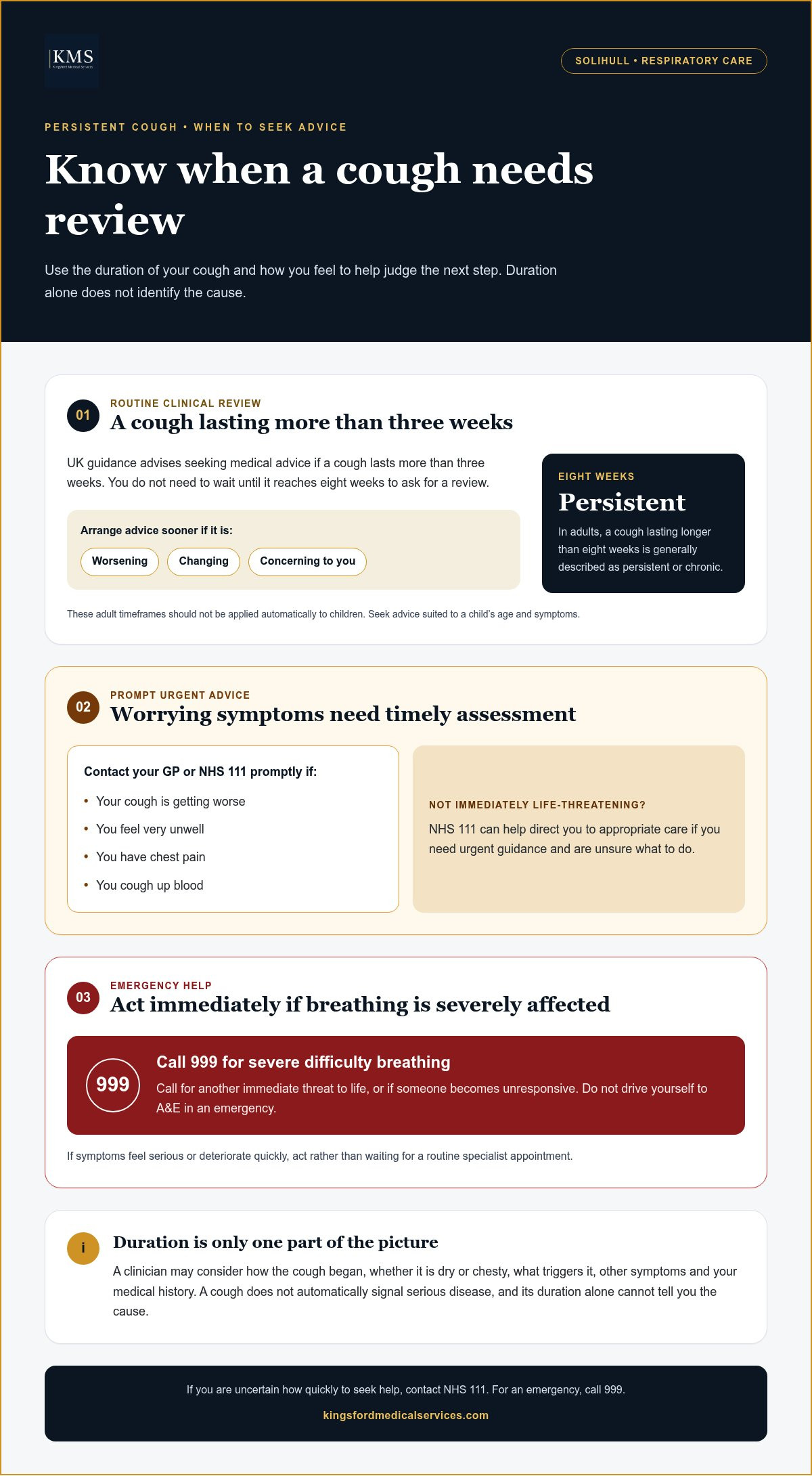
For adults, a cough lasting more than eight weeks is commonly described as persistent or chronic. That threshold is a useful clinical reference, not a diagnosis or a reason to wait before seeking advice. UK guidance recommends medical review if a cough lasts more than three weeks, particularly if it is worsening or accompanied by other concerning symptoms. A specialist for persistent cough Solihull can assess whether a respiratory consultation is appropriate when symptoms continue or the cause remains unclear.
What counts as a persistent cough?
In adults, a persistent, or chronic, cough is generally one that lasts longer than eight weeks. The NHS advises contacting a GP if a cough lasts more than three weeks, so you don’t need to wait until it reaches eight weeks to ask for a review. These adult timeframes shouldn’t be applied automatically to children. If a child’s cough concerns you, seek advice suited to their age and symptoms through an appropriate clinical service.
Duration is only one part of an assessment. A clinician will also consider the cough’s pattern, associated symptoms, relevant medical conditions, smoking history and medicines. A cough lasting several weeks may need a different response from one that is rapidly worsening or affecting breathing.
When should a cough be assessed urgently?
Seek prompt medical advice if your cough is getting worse, you feel very unwell, you have chest pain or you cough up blood. Contact your GP or NHS 111 if you need urgent guidance and your symptoms aren’t immediately life-threatening. NHS 111 can help direct you to the appropriate care when you’re unsure what to do.
Call 999 for an emergency, such as severe difficulty breathing, or if someone becomes unresponsive. Don’t drive yourself to A&E in an emergency. If symptoms feel serious or deteriorate quickly, act rather than waiting for a routine specialist appointment.
Routine review: arrange clinical advice for a cough lasting more than three weeks, or sooner if it is persistent, changing or concerning to you.
Urgent advice: use NHS 111 or contact your GP promptly for worrying symptoms that need assessment but aren’t immediately life-threatening.
Emergency help: call 999 for severe breathing difficulty or another immediate threat to life.
This article can’t assess your symptoms or replace urgent medical care. If you’re uncertain about how quickly to seek help, contact NHS 111; if there’s an emergency, call 999.
What can a respiratory specialist assess when a cough will not settle?
A respiratory specialist focuses on breathing, lung health and related symptoms, including an ongoing cough. Their role is to bring the details together: how the cough behaves, what else you’re experiencing and what an examination shows. This helps shape a considered plan rather than relying on a one-size-fits-all remedy.
At a consultation, expect the discussion to start with your symptoms and medical history, followed by an examination. A specialist for persistent cough Solihull will use these findings, along with any previous results, to decide whether further investigation or a change in management may be appropriate. The aim is to understand your concerns and agree on useful next steps, not to promise a diagnosis in one appointment.
What information helps explain an ongoing cough?
Small details can help build a clearer clinical picture. Before your appointment, consider when the cough began, whether it is dry or brings up phlegm, what seems to trigger it and how it has changed. Mention breathlessness, wheeze or other symptoms, as well as relevant smoking or vaping history, current medicines and previous respiratory conditions. You don’t need to interpret these details yourself; simply describe what you’ve noticed.
Could tests be part of a cough assessment?
Testing isn’t automatic. The specialist considers your symptoms, examination and any investigations you’ve already had before deciding whether further diagnostics could help. Kingsford Medical Services provides access to diagnostics, with the appropriate next step guided by clinical findings. Bring existing reports or results if you have them, so they can be considered alongside your account rather than repeated without reason.
For some people, careful history-taking and examination help determine the next step; others may need further investigation. If tests are considered, the clinician can explain what they are intended to clarify and how the results may inform your care. Advice may also include practical measures suited to your circumstances. The American Lung Association provides general information on managing chronic cough, although individual advice should reflect your own assessment.
Kingsford Medical Services provides respiratory and sleep medicine consultations in Knowle, Solihull, with in-person and e-consultation options. You can find further details about the private respiratory clinic in Solihull. If a cough is continuing to affect you, a respiratory consultation offers a structured opportunity to discuss your symptoms and agree what to do next. Explore respiratory consultations at Kingsford Medical Services as a local route to that review.
Private GP or respiratory specialist in Solihull: which route fits?
Choosing where to start depends on what you need help with. A private GP appointment can provide an initial review when a cough is new, unclear or hasn’t yet been assessed. A respiratory consultation focuses specifically on lung and breathing concerns, particularly if symptoms persist or recur. Neither route is automatically right for everyone, and private consultations are not a replacement for your usual NHS care.
The appropriate route depends on your clinical history, symptoms and any assessment or test results already available. Use the comparison below as a guide to the focus of each appointment, rather than as a way to diagnose yourself.
Private GP appointment
May suit: a cough that hasn’t previously been reviewed, or symptoms whose cause or next step is unclear.
Focus: an initial clinical review of your concerns and relevant health history, with advice on appropriate next steps.
Existing investigations: available results or previous correspondence can inform the discussion.
Main concern: getting an initial perspective on symptoms that may involve more than one aspect of your health.
Respiratory medicine consultation
May suit: ongoing or recurring symptoms where lung or breathing concerns are central to your reason for seeking review.
Focus: a specialist assessment of respiratory symptoms in the context of your history and examination.
Existing investigations: previous respiratory diagnoses, test results or imaging can help inform the consultation.
Main concern: discussing a cough alongside symptoms such as wheeze or breathlessness, or reviewing an existing lung concern.
When might a private GP appointment be a useful first step?
If you haven’t had the cough assessed, or you’re uncertain which type of review is appropriate, a private GP can provide a considered first clinical discussion. They can hear how symptoms have developed, review your health history and advise on suitable next steps. This can help clarify whether continued GP care or a respiratory-focused consultation better matches your concern. Kingsford Medical Services provides private GP care in Solihull.
When might respiratory expertise be relevant?
A specialist discussion may be relevant if respiratory symptoms are persistent, keep returning, or occur alongside an existing lung diagnosis. Previous investigations can be considered as part of the overall picture; having test results doesn’t, by itself, determine what further assessment is needed. A specialist for persistent cough Solihull can focus the consultation on your respiratory concerns and help shape an individual plan.
It’s reasonable to hope a cough will settle, and some do. Persistence, recurrence, worsening or associated symptoms can make a clinical review worthwhile. Continue using your usual NHS services for ongoing care, and seek urgent help for urgent symptoms rather than waiting for a routine appointment. For a local respiratory consultation, explore Kingsford Medical Services’ respiratory care in Knowle, Solihull.
How to prepare for a persistent-cough consultation in Solihull
A little preparation can help you explain what has been happening and make the consultation more focused. You don’t need to arrive with a diagnosis or know which investigations you might need. A clear account of your symptoms, relevant records and the questions you want answered give the clinician a helpful starting point.
A simple symptom diary to bring along
For a few days before your appointment, jot down brief observations rather than trying to interpret them. Note when the cough began, whether it is changing and any patterns you’ve noticed. Include possible triggers, the time of day symptoms are most noticeable, whether coughing interrupts sleep and how it affects everyday activities. Record other symptoms too, such as wheeze or breathlessness. The diary is a memory aid, not a tool for self-diagnosis.
Use this short sequence to organise your notes:
Set out the timeline: note when the cough started and whether it has improved, worsened or returned after settling.
Describe its pattern: record whether it is dry or productive, when it tends to happen and anything that appears to trigger it.
Capture its impact: mention disrupted sleep, difficulty with usual activities or other symptoms you’ve noticed.
Gather health details: prepare a current medicine list, including doses if known, and note relevant medical history, previous respiratory conditions, and smoking or vaping history.
Collect useful records: bring available test results, investigation reports and relevant letters from previous consultations.
Records and questions worth preparing
Keep your notes concise. You could write down your main concern in one sentence, such as “the cough keeps returning” or “it’s stopping me sleeping”, then list what you hope the appointment will clarify. For example, you may want to understand what the assessment involves or what the next step could be. This helps ensure the concern that matters most to you is discussed.
If you have previous test results, bring the reports rather than relying on memory of what they showed. Include relevant letters and details of medicines you’ve tried, including whether they helped or caused problems. A guide to a private respiratory clinic in Solihull can also help you understand the wider consultation context.
No checklist can predict which tests or treatment, if any, will be appropriate. Those decisions depend on your history, symptoms and clinical assessment. If you’re preparing to see a specialist for persistent cough Solihull, bring what you have; there’s no need to delay an appointment because a record or detail is missing. Arrange a respiratory consultation with Kingsford Medical Services to discuss your ongoing cough and prepare for an individual assessment.
Persistent cough assessment at Kingsford Medical Services
If an ongoing cough is affecting your comfort or leaving you unsure about the next step, a respiratory consultation can provide a focused clinical review. Kingsford Medical Services offers respiratory and sleep medicine consultations at its clinic in Knowle, Solihull. Dr Farrukh Rauf is identified by the clinic as a consultant respiratory physician, with experience focused on respiratory concerns.
The consultation begins with your account of the cough and relevant medical history, alongside a clinical assessment. Findings guide any discussion about further tests, treatment options or follow-up. Next steps are individual: an appointment can help clarify what may be appropriate, but it cannot guarantee a particular diagnosis or outcome.
What local access at Kingsford can offer
The Knowle clinic serves Solihull and the wider West Midlands, including Birmingham and Nuneaton. Patients can choose an in-person or e-consultation, and the clinic operates seven days a week. These options provide different ways to access a consultation; the most suitable format depends on your needs and the clinical discussion required. For a broader overview of respiratory and sleep care, explore the private respiratory clinic in Solihull.
Before your appointment, a brief timeline of symptoms, your current medicine list and any relevant previous results can help you make the most of the conversation. You can also note what you most want clarified, such as how the cough has changed or what the possible next steps might be. If you have no previous test results, that’s all right; the assessment starts with the information available.
How to take the next step
If your cough is continuing or recurring, consider booking a respiratory consultation to discuss your symptoms and receive an individual assessment. Seeking a specialist for persistent cough Solihull can be a considered next step when you would value focused input on respiratory concerns. You don’t need to arrive with a diagnosis; explaining what you’ve experienced is a practical place to begin.
Routine private consultation isn’t the right route for urgent warning signs. If symptoms need urgent attention, use NHS 111 or contact your GP for guidance; call 999 for an emergency. For ongoing symptoms that are not an emergency, book a respiratory consultation with Kingsford Medical Services in Knowle. This gives you a local opportunity to discuss your concerns and understand what assessment or follow-up may be appropriate.
Take the next step towards clearer answers
You don’t need to work out the cause of a cough before asking for help. The useful next step is to have your symptoms considered in context, including how they affect your sleep, routines and peace of mind. A focused conversation can help turn uncertainty into a clearer plan, even if further assessment is needed before the cause becomes clear.
If you’ve been weighing up whether to seek advice, consider what would make you feel more informed: understanding possible next steps, discussing symptoms that keep returning, or reviewing how the cough is affecting daily life. A specialist for persistent cough Solihull can provide a respiratory-focused discussion tailored to your concerns, without assuming that every ongoing cough has the same explanation.
When you feel ready, take that step at a pace that suits you. Book a respiratory consultation with Kingsford Medical Services to discuss your ongoing cough and the assessment that may be appropriate. A clear conversation is a constructive place to begin, and you don’t have to manage the uncertainty alone.
Frequently Asked Questions
Is a persistent cough always a sign of a serious condition?
No, a persistent cough doesn’t automatically mean you have a serious condition. Duration alone can’t identify the cause, and a clinician considers your symptoms alongside your health history and examination. If the cough is concerning you, arrange a review rather than trying to diagnose it online. For urgent help, use NHS 111; call 999 if someone is experiencing a life-threatening emergency.
How long should a cough last before I see a specialist?
There isn’t one timeframe that suits every age and situation. Seek medical advice if your cough isn’t improving, keeps returning, affects sleep or daily activities, or comes with other symptoms. Children may need age-specific advice, so don’t apply an adult duration threshold to them. Current NHS guidance can help you judge what to do, and a clinician can advise whether respiratory expertise would be useful.
Can I see a respiratory specialist in Solihull without a GP referral?
Kingsford Medical Services provides respiratory and sleep medicine consultations in Knowle, Solihull. If you’re searching for a specialist for persistent cough Solihull, describe your concern when arranging a consultation. For urgent symptoms, seek NHS help rather than waiting for a routine appointment.
What happens during a consultation for a persistent cough?
The clinician will ask about your symptoms, health background and any previous assessments, then decide what further review may be appropriate. You can help make the discussion useful by explaining what has changed since the cough began and what you most want addressed. If a test or follow-up is suggested, ask what it is intended to clarify and how you’ll receive the next steps. A diagnosis isn’t guaranteed in one appointment.
Should I see a GP or a respiratory specialist for an ongoing cough?
A GP may be a sensible starting point if you haven’t discussed the cough with a clinician or aren’t sure what kind of review you need. A respiratory consultation may better suit concerns centred on ongoing or recurring breathing symptoms, particularly if you have an existing lung condition. Your usual NHS care remains important; the appropriate route depends on your circumstances. For an emergency, call 999.
What should I bring to a cough appointment?
Bring medicine details, including inhalers or treatments you’ve stopped, if relevant, and any previous letters or test reports you can access. If you can’t remember a medicine’s name, a photo of its packaging may help. You might also note questions you don’t want to forget, such as whether symptoms could relate to a recent change in routine. Missing paperwork shouldn’t stop you seeking advice.
Can an online consultation assess a persistent cough?
An e-consultation can be a useful way to discuss symptoms and medical history, but remote review won’t suit every concern. The clinician will consider whether an online assessment provides enough information or whether an in-person examination or another form of care is needed. Kingsford Medical Services offers e-consultation options for patients in Solihull and the wider West Midlands. Seek urgent NHS care if serious symptoms develop.


Comments