
Private Nutrition Consultant in the West Midlands: How to Find the Right Support
The right nutrition support should match your health needs and the level of clinical care you require, not just a job title. If you’re searching for a private nutrition consultant West Midlands, you may be unsure whether a nutritionist, dietitian or medically informed service is the best fit, particularly if you’re managing weight concerns, diabetes or another health issue.
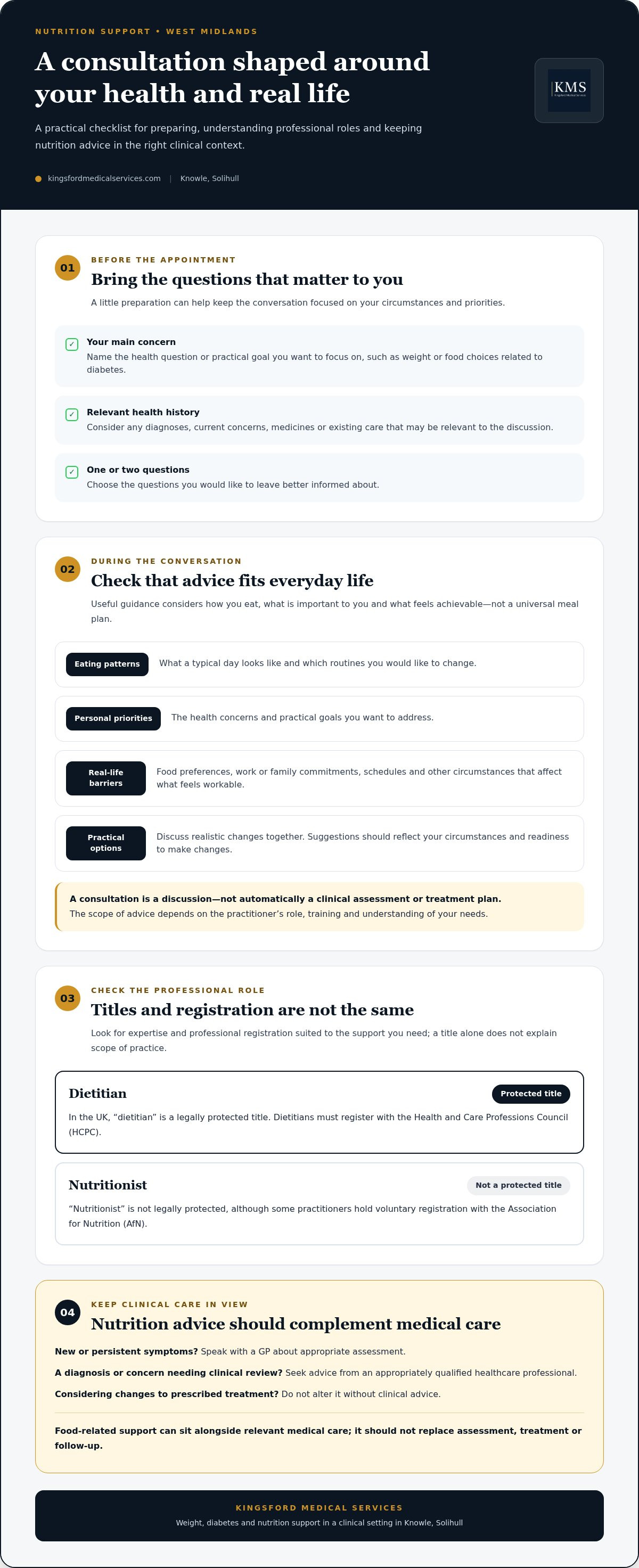
In the UK, “dietitian” is a legally protected title, and dietitians must register with the Health and Care Professions Council (HCPC). “Nutritionist” isn’t a legally protected title, although some practitioners hold voluntary registration with the Association for Nutrition (AfN). Understanding the difference helps you ask focused questions and find support that complements, rather than complicates, your existing healthcare.
This guide explains what nutrition support can cover, how to assess professional credentials and what to discuss at a first appointment. It also shows how local private support can fit alongside medical care. At Kingsford Medical Services in Knowle, Solihull, weight, diabetes and nutrition support sits within a broader clinical setting, with attention to your circumstances and concerns.
Table of Contents
Private nutrition consultant in the West Midlands: what support can cover
How a nutrition consultation can connect food choices with health needs
Dietitian, nutritionist or consultant: how to compare support in the West Midlands
Prepare for a private nutrition consultation near Knowle and Solihull
Nutrition and weight support at Kingsford Medical Services in the West Midlands
Private nutrition consultant in the West Midlands: what support can cover
The right kind of nutrition support depends on what you want help with, your health context and the professional’s role and training. A consultation gives you space to describe your eating patterns and priorities, then consider practical steps that suit your circumstances. It is not automatically a clinical assessment or treatment plan.
A nutrition consultation is a discussion about how you eat, the health context that matters to you and the practical goals you want to work towards. Rather than beginning with a fixed diet plan, a useful conversation starts with your circumstances and explores realistic options. The term “nutritionist” is used in different ways; What is a Nutritionist? provides a general overview. The appropriate scope of advice depends on the practitioner’s training and your needs.
Support may involve general food and lifestyle guidance, or sit within a wider clinical conversation. This distinction matters if you have a diagnosis, symptoms or a health concern that needs medical assessment. Choose a private nutrition consultant in the West Midlands whose expertise fits the question you want to address, rather than relying on a title alone.
What might a private nutrition consultation discuss?
A useful conversation considers everyday habits alongside your health priorities. You might discuss meal routines, food preferences, work or family commitments, and what makes changes hard to maintain. These details help shape practical options. Advice should be individual, not a universal meal plan presented as suitable for everyone.
Eating patterns: what a typical day looks like and which routines you’d like to change.
Personal priorities: the health questions or practical goals you want to focus on.
Real-life barriers: preferences, schedules or circumstances that affect what feels achievable.
The conversation and any suggestions depend on the professional’s role, training and understanding of your circumstances. You should be able to explain what matters to you without being judged against idealised rules. Before an appointment, identify one or two questions you’d like to leave better informed about.
When might local nutrition support be relevant?
Local support can help if you want structured guidance around weight or have questions about food and diabetes. These concerns can involve more than meal choices, so the wider health picture matters. Kingsford Medical Services provides weight, diabetes and nutrition support in a clinical setting in Knowle, Solihull, for patients across the West Midlands, including Birmingham and Nuneaton.
If you have new or persistent symptoms, or a diagnosis that needs clinical review, speak with a GP about appropriate assessment. Nutrition advice should complement relevant medical care, not replace it. This is particularly important if a health concern needs diagnosis or treatment before dietary changes are considered.
How a nutrition consultation can connect food choices with health needs
Food choices are one part of health, not the whole picture. A useful consultation considers how eating habits fit alongside your wider circumstances rather than treating one meal or ingredient as the answer. Nutrition advice is most relevant when it reflects your health context, priorities and everyday life.
A clinician may ask about your health history, current concerns and usual eating patterns. Depending on the reason for the appointment, the discussion could include existing diagnoses, medicines, food preferences, daily routines and changes you feel ready to make. These questions provide context; they don’t mean every consultation involves the same assessment or leads to a particular plan.
Goals can then be discussed in practical terms. For example, someone with a busy routine might explore manageable changes to meal planning, while another person may have questions about how everyday food choices relate to a health concern. The aim is to consider realistic options together, not prescribe a universal menu or promise a particular result.
Nutrition, weight management and diabetes care
Food choices can form one part of wider support for weight or diabetes. They should be considered alongside relevant clinical advice, not as a replacement for medical assessment, prescribed treatment or follow-up. For general information about specific nutrients, the NHS guide to vitamins and minerals is a useful starting point. Individual concerns still need to be understood in context.
If symptoms or a diagnosis need assessment, speak with an appropriately qualified healthcare professional. Diagnosis and treatment decisions belong with professionals whose qualifications and scope of practice cover that care. Nutrition discussions can help you consider food-related questions, but shouldn’t delay assessment or lead you to alter prescribed treatment without clinical advice.
What personalised support should take into account
Good guidance starts with what matters to you and what is workable. Your health priorities, routines, preferences and readiness to make changes all affect which suggestions may be appropriate. Recommendations should be practical enough to consider in daily life and responsive to your circumstances.
Health context: relevant concerns, diagnoses and existing care that may shape the discussion.
Daily routines: when and how you usually eat, alongside practical constraints.
Personal preferences: foods and approaches you’re comfortable considering.
Readiness: the pace and type of change that feels manageable to you.
A private nutrition consultant in the West Midlands should make space for these details and explain recommendations clearly. For people considering support around weight or diabetes, Kingsford Medical Services in Knowle, Solihull offers a local clinical setting to discuss nutrition as part of wider care. Explore weight, diabetes and nutrition support to start a conversation that takes your health needs into account.
Dietitian, nutritionist or consultant: how to compare support in the West Midlands
A professional title is a useful clue, but it doesn’t tell you everything about the support on offer. Match your health question with the practitioner’s training, registration and scope of practice. A reassuring title alone doesn’t establish clinical suitability, particularly if you have symptoms or a diagnosed condition.
What do dietitian and nutritionist titles mean in the UK?
The titles have different regulatory status. The HCPC regulates dietitians, and “dietitian” is a protected title. The British Dietetic Association (BDA) is the professional body for dietitians, while registration can be checked through the HCPC. “Nutritionist” isn’t a legally protected title; some practitioners voluntarily register with the Association for Nutrition (AfN).
These distinctions mean the terms aren’t interchangeable. If someone uses the title dietitian, you can check their name on the HCPC register. AfN registration is a useful credential to consider when looking at a nutritionist, but it isn’t the same as statutory regulation. Consider the practitioner’s training and the nature of your concern together.
How should your health question shape the choice?
For general questions about everyday eating habits or lifestyle, look for a practitioner whose training matches the subject. If your concern involves symptoms, a diagnosis or treatment decisions, clinical assessment may be needed. Consider whether the professional is qualified to assess the issue or whether a GP or another appropriately qualified healthcare professional should be involved.
Weight and diabetes questions can involve more than food choices. Wider medical context, including existing diagnoses and care, may affect what advice is suitable. A nutrition discussion can form part of that support, but shouldn’t replace assessment, prescribed treatment or follow-up. If you’re considering broader health assessment, think about the purpose of a health check as well as nutrition guidance.
General food guidance: identify the specific habits or practical questions you want to discuss.
Symptoms or diagnosis: prioritise appropriate clinical assessment and clarify how nutrition advice fits alongside it.
Weight or diabetes: consider support in the context of your wider health needs and existing care.
For patients in the West Midlands, Kingsford Medical Services provides weight, diabetes and nutrition support within a broader clinical setting in Knowle, Solihull. The clinic is led by GMC-registered clinicians, giving patients from Solihull, Birmingham and Nuneaton a local route to discuss relevant health concerns. Medical registration and nutrition qualifications are distinct, so it is useful to understand the professional’s role when choosing support.
Prepare for a private nutrition consultation near Knowle and Solihull
A little preparation can help you use an appointment well, but you don’t need a perfect food diary or a fixed target. A conversation with a private nutrition consultant in the West Midlands can start with what matters to you: a health question, a concern about eating habits or support with a change you’re considering.
What information may help make the discussion useful?
Focus preparation on details relevant to your reason for seeking support. Note a diagnosis, medicines or previous healthcare advice if they could affect the discussion. You don’t need to collect unrelated personal information or change your diet or medication beforehand. If you’re unsure whether something is relevant, raise it during the appointment.
Use this short sequence to organise your thoughts:
Define your main concern. Write down the health question or eating-related issue you most want to discuss.
Note relevant context. Include diagnoses, medicines or previous advice that may relate to that concern, where appropriate.
Identify a practical priority. Consider what you’d like to understand or what change you might be ready to explore.
Your priorities can guide the conversation. You don’t have to set a particular weight, commit to a specific diet or arrive knowing the solution. The clinician can first understand your concern and relevant health context, then discuss what may be appropriate. Be open about what feels manageable and any practical barriers that could affect your choices.
Questions to ask during your appointment
Good questions help clarify how advice fits your circumstances and what to expect next. Save this checklist on your phone or bring it to a consultation near Knowle or Solihull:
How does your advice take account of my health history and current priorities?
How might nutrition support fit alongside any existing care or treatment?
Are there changes you recommend I discuss with another healthcare professional first?
How will we know whether the agreed approach is useful for me?
What might the next steps be, and how would progress be reviewed?
These questions help you understand the reasoning behind suggestions, rather than leaving with instructions that feel difficult to apply. If weight or diabetes is part of your concern, make sure the wider health context is included. Bring relevant information you already have, but don’t stop or alter prescribed treatment unless the clinician responsible for your care advises you to do so.
Kingsford Medical Services is based in Knowle, Solihull, and provides weight, diabetes and nutrition support for patients across the wider West Midlands, including Birmingham and Nuneaton. Explore weight, diabetes and nutrition support to discuss these concerns in a local clinical setting.
Nutrition and weight support at Kingsford Medical Services in the West Midlands
Nutrition questions often sit alongside wider concerns about weight, diabetes or general health. Kingsford Medical Services provides weight, diabetes and nutrition support in a private clinical setting, giving patients a local way to discuss these concerns in context. The discussion can focus on the issues you want to raise without assuming a particular treatment or outcome.
A local clinic for weight, diabetes and nutrition needs
Based in Knowle, Solihull, Kingsford Medical Services serves patients across the wider West Midlands. For someone looking for a private nutrition consultant in the West Midlands, the clinic offers a nearby place to discuss food-related questions alongside relevant weight or diabetes concerns. The clinic is led by GMC-registered clinicians Dr Farrukh Rauf and Dr Anbrin Farrukh. Their medical registration does not imply a particular dietitian or nutritionist qualification.
Considering nutrition in a broader clinical setting can be useful when your question relates to an existing diagnosis, current treatment or another health concern. Explain what you want help understanding, then discuss how nutrition support fits alongside other relevant care. This helps you consider food choices as part of your health, without treating them as separate from it or suggesting they replace medical assessment.
The right discussion depends on your circumstances. You might raise a question about eating habits in relation to weight, or explore how nutrition fits into the wider picture of diabetes care. Bring your priorities into the conversation, including any relevant medical advice. The aim is to make the next step clear and appropriate, not to promise a specific result.
How to take the next step with Kingsford
Kingsford Medical Services operates seven days a week, with in-person and e-consultation options across the clinic. The suitable format depends on the appointment and the concern you want to discuss.
Before taking the next step, consider whether your main question is about nutrition, weight, diabetes or a combination of concerns. If you already receive care elsewhere, have relevant information to hand so the discussion can take that context into account. You don’t need to settle on a diet target or plan first; start with the health question that matters to you.
If you’re based in Knowle, Solihull, Birmingham, Nuneaton or elsewhere in the West Midlands, explore Kingsford Medical Services’ weight, diabetes and nutrition care to begin discussing your needs. A clear starting point can help you feel prepared to talk through your concerns and the support that may be appropriate.
Take a considered next step towards nutrition support
You don’t need every answer before seeking support. Start with the health question you most want to address, then look for care that considers it in the context of your circumstances. If you’re searching for a private nutrition consultant West Midlands, a conversation about your priorities can help you understand what kind of support may suit you alongside your wider healthcare.
Kingsford Medical Services brings weight, diabetes and nutrition support together within a private medical setting. The clinic is in Knowle, Solihull, and serves patients across the wider West Midlands, including Birmingham and Nuneaton. Its clinical leadership includes GMC-registered clinicians Dr Farrukh Rauf and Dr Anbrin Farrukh, providing a local setting in which to raise relevant health concerns.
Take the next step at a pace that feels manageable. Explore care at Kingsford Medical Services and find a starting point for discussing your nutrition or related health needs. A clear first question is enough to begin.
Frequently Asked Questions
Do I need a GP referral to see a private nutrition consultant in the UK?
Usually, you can approach a private nutrition consultant directly, but referral arrangements vary between services and practitioners. If you’re searching for a private nutrition consultant in the West Midlands, first clarify the concern you want help with and whether it involves a diagnosed condition. A GP referral may be useful if you need medical assessment or want nutrition support to sit alongside existing care. Check your insurer’s terms too, as they may set separate referral requirements.
Can I discuss private nutrition support alongside NHS care?
Yes, private nutrition support can be discussed alongside NHS care. Let the clinicians involved in your care know about advice you’re receiving, particularly if it relates to a diagnosis, treatment or dietary restrictions. This helps avoid conflicting recommendations and gives each professional a clearer picture of your care. Ask how proposed changes fit with your NHS plan, and keep following existing clinical advice unless the responsible healthcare professional recommends a change.
How soon might I notice changes after receiving nutrition advice?
There’s no fixed timescale for noticing changes, and no particular result can be guaranteed. It depends on your starting point, health circumstances, the changes discussed and how they fit into daily life. Some practical adjustments may feel manageable quickly, while changes in health markers or symptoms can require clinical monitoring. Agree what you’ll pay attention to with your clinician, and seek medical advice if symptoms worsen rather than waiting for dietary changes to take effect.
Can a nutrition consultant diagnose a food allergy?
A nutrition consultant’s title alone doesn’t establish that they’re qualified to diagnose a food allergy. Allergy symptoms need appropriate medical assessment, as removing foods without guidance can affect nutrition and may not identify the cause. If you suspect an allergy, discuss your symptoms with a GP or an appropriately qualified healthcare professional. A nutrition professional may be able to support food choices after assessment, but shouldn’t be treated as a substitute for diagnosis.
Will private health insurance cover a nutrition consultation?
Cover depends on your individual policy, the reason for the appointment and the practitioner’s recognised qualifications or registration. Some policies require a referral or pre-authorisation, and exclusions may apply to weight-related support or general wellbeing advice. Before booking, review your policy documents or speak with your insurer about the exact type of consultation you’re considering. Ask what evidence they need for a claim, and keep any referral or appointment paperwork they request.
Is a private nutrition consultation suitable if I take regular medication?
It may be suitable, but tell the clinician about medicines relevant to your nutrition question so advice can be considered safely. Bring an up-to-date medication list, including prescribed medicines and any supplements you take, if they’re relevant. Don’t stop, adjust or replace medication based on general nutrition advice. If a proposed dietary change could affect how you take a medicine, check with the healthcare professional responsible for prescribing it before making that change.
Can I attend a nutrition appointment without keeping a food diary?
Yes, you can attend without a food diary. Describe your usual routine in your own words, such as when you tend to eat, what makes meals difficult and what you’d like to understand. If you already have notes that feel useful, bring them, but don’t create a detailed record unless you’re comfortable doing so. The discussion can begin with your main question, and the clinician can explain whether further information would help.


Comments